Introduction: The Next Chapter of Indian Business Is Being Written Online — Right Now
Here’s something worth sitting with for a moment.
In 2010, India had approximately 100 million internet users. Today, that number has crossed 900 million — and we’re still not done growing. By 2030, projections suggest India will have over 1.2 billion internet users, making it the single largest digital audience on the planet. The Future of Digital Marketing in India looks promising with rapid digital growth.
That’s not just a statistic. For businesses operating in India, it represents the most significant marketing opportunity in the country’s history. Many experts are optimistic about the Future of Digital Marketing in India.
But here’s the real question: what does the future of digital marketing in India actually look like — and is your business positioned to take advantage of it?
Because the digital marketing landscape of 2026 looks dramatically different from even three years ago. Artificial intelligence is rewriting how content gets created and how ads get optimized. Regional language internet users are outnumbering English speakers. Short-form video has overtaken text as the dominant content format. And entirely new channels — from connected TV advertising to WhatsApp commerce — are opening up for forward-thinking businesses.
The future isn’t coming. In many ways, it’s already here.
This guide breaks down the 12 most important trends shaping the future of digital marketing in India, what each one means for your business, and how to get ahead of them before your competitors do.
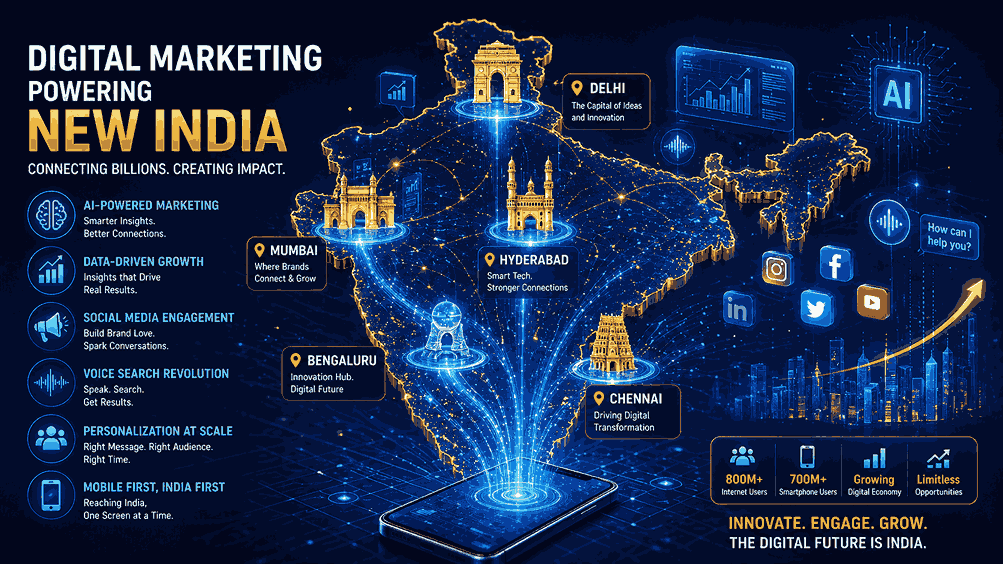
A futuristic illustration showcasing how digital marketing technologies and AI are transforming major cities across India.
Why the Future of Digital Marketing in India Is Unlike Any Other Market
Before we dive into the trends, it’s worth understanding why India specifically represents such a unique — and uniquely exciting — digital marketing frontier. The Future of Digital Marketing in India is driven by technology and innovation.
India isn’t just a large market. It’s a market with a set of characteristics that make it genuinely one-of-a-kind:
The scale of mobile internet adoption — India consumes more mobile data per capita than almost any country in the world. The average Indian smartphone user spends over 4.5 hours per day on their device.
The regional language explosion — Over 600 million Indian internet users prefer content in languages other than English. Hindi, Tamil, Telugu, Kannada, Marathi, Bengali, and Gujarati content consumption is growing 3–4x faster than English.
The UPI revolution — With over 13 billion UPI transactions per month, India has effectively solved the digital payments problem — removing the biggest historical barrier to e-commerce and digital commerce at scale.
The youth demographic — India has one of the youngest populations in the world, with a median age of approximately 28. This is a digital-native audience that has grown up with smartphones, social media, and online shopping.
Tier-2 and Tier-3 city growth — The next wave of Indian internet users isn’t coming from Mumbai or Delhi. It’s coming from Indore, Coimbatore, Patna, Surat, Nagpur, and thousands of smaller cities and towns where digital adoption is accelerating rapidly.
Understanding these characteristics is essential context for everything that follows. The future of digital marketing in India isn’t just a scaled-up version of global trends — it’s a uniquely Indian story. Many businesses are investing in the Future of Digital Marketing in India.
12 Trends Defining the Future of Digital Marketing in India
Trend 1 — Artificial Intelligence Will Power Every Marketing Decision
If there’s one force that will define the future of digital marketing in India more than any other, it’s Artificial Intelligence. The Future of Digital Marketing in India is shaping the next generation of marketing.
AI is no longer a futuristic concept. It’s already embedded in the tools Indian businesses use every day — from Google Ads’ automated bidding systems to Instagram’s content recommendation algorithms to the AI-powered chatbots handling customer queries on e-commerce websites. Understanding the Future of Digital Marketing in India can help businesses stay ahead.
But the next wave goes much deeper:
AI-generated content — Tools like Claude, ChatGPT, and Gemini are helping businesses create blog posts, social media captions, email sequences, and ad copy at a speed and scale that was previously impossible for small teams.
Predictive analytics — AI analyzes behavioral data to predict what a customer is likely to buy next, when they’re most likely to churn, and which marketing message will resonate most — enabling hyper-personalized campaigns.
AI-powered ad optimization — Platforms like Google and Meta already use machine learning to automatically optimize ad targeting, bidding, and creative — but this capability is becoming significantly more sophisticated.
Conversational AI and chatbots — AI-powered chatbots are handling customer service, product recommendations, and lead qualification around the clock, without human intervention.
What this means for Indian businesses: Companies that learn to work with AI as a marketing partner — rather than fearing it — will have a significant competitive advantage. The goal isn’t to replace human creativity and strategy, but to augment it.
Trend 2 — Regional Language Digital Marketing Becomes Non-Negotiable
Here’s a trend that Indian businesses outside metro cities should pay particular attention to. The Future of Digital Marketing in India is evolving with changing consumer behavior. The Future of Digital Marketing in India makes it a valuable field to explore today.
India’s next 300 million internet users will not be English speakers. They’ll be Hindi-speaking users in UP and Bihar, Tamil-speaking users in smaller Tamil Nadu towns, Telugu-speaking users in Andhra Pradesh districts, and Marathi-speaking users in Maharashtra’s interior regions. Businesses are adapting quickly to the Future of Digital Marketing in India.
Google reports that regional language content consumption in India is growing at 2–3x the rate of English content. YouTube already has more regional language viewers than English in India. Voice search queries in regional languages are exploding.
For businesses, this creates both a challenge and an enormous opportunity:
Businesses that create content, ads, and customer communication in regional languages will access audiences that competitors are entirely ignoring
Regional language SEO is significantly less competitive than English SEO — meaning businesses can rank faster and at lower cost
WhatsApp communication in regional languages builds deeper customer trust and engagement than English-only communication
A real-world illustration: A Jaipur-based jewelry brand began creating Hindi-language Instagram reels showcasing their bridal jewelry collections — specifically targeting non-metro audiences in Rajasthan, UP, and MP who consume content primarily in Hindi. Their engagement rates were 4–5x higher than their English content, and their customer inquiries from Tier-2 cities doubled within six months. They hadn’t changed their product — they’d changed the language they were speaking to their audience in.
Trend 3 — Short-Form Video Dominance Will Intensify
Short-form video is not a trend that’s peaking — it’s a trend that’s still accelerating.
Instagram Reels, YouTube Shorts, and similar short-form formats have fundamentally changed how Indian audiences — particularly those under 35 — discover brands, evaluate products, and make purchasing decisions. The Future of Digital Marketing in India is becoming more competitive and dynamic. The Future of Digital Marketing in India is opening doors for innovation and creativity.
Some context on the scale:
YouTube is the second-most visited website in India, with over 450 million active users
Instagram Reels in India generate billions of views every month
The average Indian under 30 watches over 45 minutes of short-form video content daily
For businesses, this means that short-form video is no longer a creative experiment — it’s a primary marketing channel that demands investment and consistency.
The opportunity hiding in plain sight: Most Indian businesses — particularly in B2B, professional services, manufacturing, and traditional retail — are producing almost zero video content. A business that commits to 3–4 short-form videos per week, consistently, in a category with no video competition, can build a substantial audience in 6–12 months at minimal cost.
Types of short-form video that work for businesses in India:
Quick tips and hacks relevant to your industry
Behind-the-scenes of your product creation or service delivery
Customer testimonials in conversational, authentic formats
Myth-busting content addressing common misconceptions in your category
“Day in the life” content humanizing your brand and team
Trend 4 — Hyper-Personalization Will Replace Mass Marketing
The era of sending the same message to your entire audience is ending — rapidly.
Consumers in 2026 expect brands to know who they are, understand their preferences, and communicate in ways that feel personally relevant. Research consistently shows that personalized marketing experiences drive 6–8x higher ROI than generic mass campaigns. The Future of Digital Marketing in India is transforming how brands connect with audiences.
In practice, hyper-personalization means:
Segmented email campaigns — Sending different emails to different customer segments based on their purchase history, browsing behavior, and stated preferences
Dynamic website content — Showing different content to a first-time visitor versus a returning customer versus an existing purchaser
Behavioral retargeting — Serving ads that reflect the specific products someone viewed or the specific content they engaged with
Personalized WhatsApp communication — Using customer data to send relevant product recommendations, reorder reminders, and personalized offers rather than broadcast promotions
For Indian businesses, this shift requires investing in basic CRM (Customer Relationship Management) systems and email marketing platforms that enable audience segmentation. It doesn’t require enterprise-scale technology — tools like Mailchimp, HubSpot, or even well-organized WhatsApp Business contacts can power meaningful personalization for small and mid-sized businesses. The Future of Digital Marketing in India is expected to expand across industries. The Future of Digital Marketing in India depends on continuous digital adoption.
Trend 5 — Voice Search and Vernacular Search Will Reshape SEO
“Ok Google, kahan milega best dhaba near me?”
Voice search in India — particularly in regional languages — is growing at a pace that’s fundamentally changing how businesses need to think about SEO.
Several factors are driving this:
Affordable smartphone penetration in Tier-2 and Tier-3 cities
Improved regional language recognition by Google’s voice search
The convenience of voice for users who are less comfortable with typing on small smartphone keyboards
What voice search means for Indian business SEO:
Voice search queries are fundamentally different from typed queries. They’re longer, more conversational, and more question-based. Someone typing might search “digital marketing agency Mumbai.” The same person using voice search might say “which is the best digital marketing agency in Mumbai for small businesses?”
Businesses that optimize their content for conversational, question-based queries — particularly in regional languages — will capture this growing traffic before their competitors realize what’s happening.
Practical steps for voice search optimization:
Include natural, conversational language in your content
Create dedicated FAQ sections on your website (answering real questions your customers ask)
Optimize your Google Business Profile completely for local voice searches
Target long-tail, question-based keywords in your content strategy
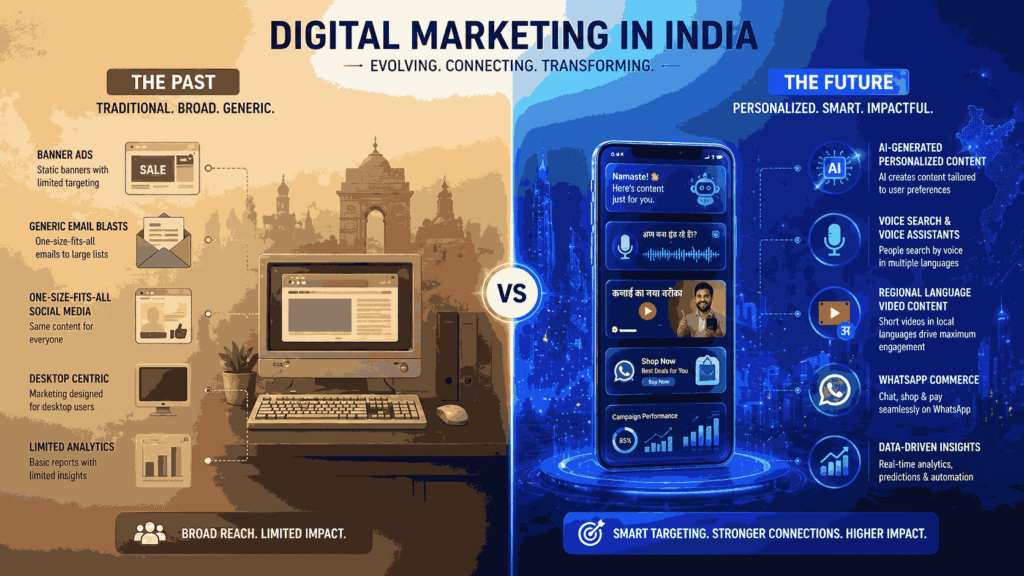
A side-by-side comparison of traditional and future digital marketing in India, highlighting the shift to AI-driven and personalized strategies.
Trend 6 — WhatsApp Commerce Will Become a Primary Sales Channel
WhatsApp is already the most used communication platform in India. But in the near future, it’s evolving from a communication tool into a complete commerce ecosystem. The Future of Digital Marketing in India is supported by growing online engagement.
WhatsApp’s business features — product catalogues, payment integration (via WhatsApp Pay), automated order management, and conversational AI-powered customer service — are turning the platform into a full-funnel sales channel. The Future of Digital Marketing in India is creating demand for skilled marketers.
For Indian businesses, the WhatsApp commerce opportunity is enormous precisely because the trust infrastructure already exists. The Future of Digital Marketing in India continues to evolve with market trends. Indian consumers are already making buying decisions through WhatsApp conversations, sharing product links with family, and asking vendors questions before purchasing.
What forward-thinking Indian businesses are already doing with WhatsApp:
Running “WhatsApp-exclusive” product launches and flash sales
Building customer loyalty groups with exclusive content and early access offers
Using WhatsApp chatbots for order tracking, size guides, and product recommendations
Click-to-WhatsApp advertising (Meta Ads that take users directly to a WhatsApp conversation with the business)
Collecting reviews and testimonials through WhatsApp post-purchase sequences
The businesses that build WhatsApp as a structured sales and retention channel now will have a significant head start as WhatsApp Commerce matures. The Future of Digital Marketing in India depends on continuous digital adoption.
Trend 7 — Connected TV (CTV) and OTT Advertising Will Open New Doors
Netflix, Amazon Prime Video, Disney+ Hotstar, JioCinema, and YouTube on television screens have created an entirely new advertising frontier that didn’t meaningfully exist in India five years ago. The Future of Digital Marketing in India is influenced by emerging technologies.
Connected TV (CTV) refers to internet-connected television — smart TVs and streaming devices that give advertisers the ability to serve targeted, data-driven ads to viewers watching streaming content.
Unlike traditional television advertising (expensive, broad, unmeasurable), CTV advertising offers:
Precise audience targeting based on demographics, interests, and viewing behavior
Real-time performance measurement
The visual and emotional impact of TV-style video ads
Access to premium content environments at a fraction of traditional TV ad costs
For Indian businesses — particularly those in categories like real estate, automobile, financial services, education, and consumer goods — OTT and CTV advertising represents a powerful emerging channel to reach premium urban and semi-urban audiences.
As streaming penetration in Indian households continues to grow, this channel will become increasingly important in the overall digital marketing mix. The Future of Digital Marketing in India is creating demand for skilled marketers.
Trend 8 — Data Privacy and First-Party Data Will Reshape Digital Advertising
This is a trend that many Indian businesses aren’t paying enough attention to — but will be forced to soon.
Globally, the era of third-party cookie-based advertising is ending. Apple’s App Tracking Transparency framework has already dramatically reduced mobile ad targeting capabilities. The Future of Digital Marketing in India is shaping the next generation of marketing.
Google’s phasing out of third-party cookies (repeatedly delayed but progressing) will further reshape how digital advertising works. The Future of Digital Marketing in India offers new opportunities for businesses.
What this means: Businesses that have relied entirely on platforms like Google and Facebook to “know” their audience for them will face increasing targeting limitations. The Future of Digital Marketing in India is expected to expand across industries. The Future of Digital Marketing in India depends on continuous digital adoption. The businesses that will thrive are those that have built first-party data — information collected directly from their own customers through owned channels.
First-party data sources for Indian businesses:
Email subscriber lists (with preference data)
WhatsApp contact lists with purchase history
Website behavioral data via Google Analytics
CRM data from past customer interactions
Loyalty program data
Building first-party data isn’t a technical exercise — it’s a strategic priority. Every email signup, every WhatsApp subscriber, every CRM record is an asset that becomes more valuable as third-party targeting becomes more restricted.
Trend 9 — Influencer Marketing Will Mature and Professionalize
India’s influencer marketing ecosystem is in the middle of a significant maturation. The early days of brands paying anyone with followers to post about their products are giving way to a far more strategic, performance-driven model. The Future of Digital Marketing in India is shaping modern marketing strategies.
Several shifts are happening simultaneously:
Micro and nano-influencers are becoming the default choice for most businesses — offering higher engagement rates, more authentic audience relationships, and significantly lower costs than celebrity endorsements.
Performance-based influencer partnerships — where influencers are paid based on results (clicks, conversions, and sales) rather than just reach — are becoming standard, making ROI measurement more transparent.
Regional influencers in Tier-2 cities are emerging as a powerful new category. A food creator in Lucknow with 35,000 highly engaged local followers might deliver better results for a regional restaurant chain than a Mumbai mega-influencer with 2 million followers.
Influencer content is being repurposed — Savvy businesses are using influencer-created content in their paid ads (User Generated Content or UGC ads), on their websites, and in their email marketing — extending the value of each collaboration significantly.
Trend 10 — Marketing Automation Will Level the Playing Field
Here’s a trend that’s particularly exciting for small and mid-sized Indian businesses: the tools that were once only accessible to large enterprises are now available to everyone.
Marketing automation platforms — which allow businesses to trigger personalized email sequences, segment audiences automatically, score leads, and nurture prospects through multi-step journeys — have become dramatically more affordable and user-friendly. Exploring the Future of Digital Marketing in India reveals strong growth potential.
What this means for Indian businesses:
A solo entrepreneur can set up an automated welcome email sequence that nurtures new subscribers for 30 days — without touching it after initial setup
A small e-commerce brand can automatically send a cart abandonment email 30 minutes after someone leaves their site, followed by a reminder 24 hours later, followed by a discount offer 72 hours later — all on autopilot
A B2B services firm can automatically send relevant case studies and articles to leads based on which pages they’ve visited on the website
Marketing automation doesn’t replace the human element of great marketing — but it scales it enormously, allowing small Indian businesses to compete with the consistency and sophistication of much larger organizations.
Trend 11 — Sustainability and Purpose-Driven Marketing Will Influence Purchase Decisions
Indian consumers — particularly millennials and Gen Z — are increasingly factoring brand values and sustainability credentials into their purchasing decisions. The Future of Digital Marketing in India is becoming more data-driven and personalized.
A 2023 study found that over 70% of Indian millennials are willing to pay a premium for brands that demonstrate genuine commitment to environmental or social causes. This isn’t just a global Western trend — it’s clearly taking root in urban and semi-urban India.
For businesses, this means that digital marketing in the future won’t just be about selling products and services — it’ll be about communicating values, demonstrating impact, and building brand purpose that resonates with a more conscious consumer base.
What this looks like in practice:
Transparent supply chain content showing ethical sourcing or manufacturing
Impact storytelling — real narratives about how your business contributes to communities or environmental goals
Purpose-driven campaigns tied to genuine organizational commitments (not “greenwashing”)
Celebrating and showcasing local artisans, small suppliers, or community partnerships
Trend 12 — The Rise of Vernacular and Regional E-Commerce
The final trend might be the most significant for businesses targeting non-metro Indian audiences.
India’s next e-commerce growth wave is coming from Bharat — the Hindi-speaking heartland, the regional language internet users, the first-generation online shoppers in Tier-2 and Tier-3 cities who are making their first online purchases in their native languages. The Future of Digital Marketing in India is closely linked to increasing internet penetration.
Platforms like Meesho, which offers a primarily Hindi-language interface and caters heavily to non-metro audiences, have shown conclusively that there are hundreds of millions of Indian consumers waiting to be served in their own language, through channels they’re comfortable with.
For businesses, this trend has concrete implications:
Building regional language versions of your website will drive significantly higher conversion rates from regional audiences
Running ads in regional languages dramatically reduces cost-per-click in many markets due to lower competition
Customer support in regional languages builds trust that no English-language interaction can replicate
Product descriptions, reviews, and UGC in regional languages help regional buyers make confident purchase decisions
How Indian Businesses Should Prepare for the Future of Digital Marketing
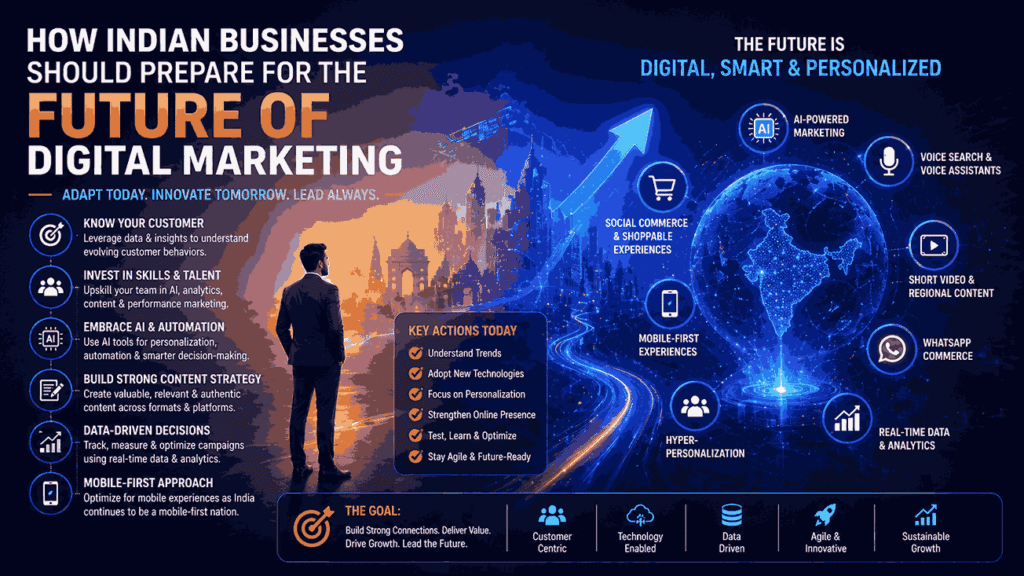
A futuristic visual guide highlighting key strategies Indian businesses must adopt to stay competitive in digital marketing.
Understanding the trends is one thing. Preparing for them is another. Here’s a practical roadmap:
In the next 30 days:
Audit your current digital marketing channels — what’s working, what’s not, and what’s missing
Set up or optimize your Google Business Profile completely
Ensure your website is mobile-first, fast, and conversion-optimized
Start building your first-party data assets — email list, WhatsApp subscriber list
In the next 90 days:
Begin publishing short-form video content consistently on 1–2 platforms
Explore regional language content if your audience is outside metro English-speaking demographics
Implement basic email marketing automation — starting with a welcome sequence
Research micro-influencer partnerships relevant to your product or service category
In the next 6–12 months:
Invest in SEO and content marketing with a long-term, compounding mindset
Build out marketing automation across email and WhatsApp
Explore CTV/OTT advertising if your budget and audience profile support it
Develop a first-party data strategy that reduces dependence on third-party platforms
Conclusion: The Future of Digital Marketing in India Belongs to Businesses That Act Now
Let’s bring everything together.
The future of digital marketing in India is not a distant, abstract concept. It’s unfolding in real time — through the 900 million Indians on the internet today, through the regional language creator who just launched a channel in a Tier-2 city, through the WhatsApp conversation that just converted a first-time buyer into a loyal customer, and through the AI tool that just helped a small business write better ads than their enterprise competitor.
Here’s a recap of the 12 trends we explored:
AI-powered marketing — Smarter content, ads, and customer experiences
Regional language digital marketing — Reaching India’s next 300 million users
Short-form video dominance — Reels and Shorts as primary discovery channels
Hyper-personalization — Right message, right person, right time
Voice and vernacular search — Reshaping how businesses approach SEO
WhatsApp commerce — A full-funnel sales channel hiding in plain sight
CTV and OTT advertising — Premium video advertising at scale
First-party data priority — Building owned audience assets
Maturation of influencer marketing — Performance-driven, authentic partnerships
Marketing automation — Leveling the playing field for smaller businesses
Purpose-driven marketing — Brand values as a competitive differentiator
Vernacular e-commerce — Serving Bharat in its own languages
The businesses that will lead their categories in 2030 are making decisions today. They’re not waiting for the trends to fully arrive before they start preparing. They’re building the skills, systems, and strategies now — so that when the opportunity fully matures, they’re already positioned to capture it.
The future of digital marketing in India is genuinely exciting. And more importantly — it’s accessible to every business willing to understand it and act on it.
The question is simply: will that business be yours?
🚀 Don’t Just Read the Future — Be Part of Building It
You’ve just invested time understanding the most important digital marketing shifts shaping India’s business landscape. Now let that knowledge work for you.
👉 Take one action this week. Not next quarter. Not when things “settle down.” Pick one trend from this list of 18 Media Advertising — the one most relevant to your business — and take a single concrete step toward it this week. Build momentum. The future rewards those who start early.
India’s digital economy is on an extraordinary trajectory. Position your business to ride that wave — not watch it from the shore. Connect with 18 Media Advertising for a FREE Consultation.
Frequently Asked Questions About the Future of Digital Marketing in India
Q1: What does the future of digital marketing in India look like for small businesses specifically? The future is particularly bright for small businesses willing to adapt. AI tools are dramatically reducing the cost and effort of content creation and ad optimization. Regional language marketing is opening up massive, underserved audiences. Short-form video can be created with just a smartphone. Marketing automation allows small teams to execute with the sophistication of large organizations. The future of digital marketing in India genuinely levels the playing field — but only for small businesses that embrace these shifts rather than waiting on the sidelines.
Q2: How will AI change the future of digital marketing in India? AI will transform digital marketing in India across multiple dimensions — from content creation and ad copywriting to audience segmentation, predictive analytics, chatbot-powered customer service, and automated campaign optimization. For Indian businesses, AI tools will reduce the skill gap that has historically prevented smaller businesses from executing sophisticated digital marketing. However, AI will augment human strategy and creativity — not replace it. The businesses that use AI as a partner rather than a replacement will have the greatest competitive advantage.
Q3: Why is regional language marketing so important for the future of digital marketing in India? India’s next 300 million internet users will primarily consume content in Hindi, Tamil, Telugu, Kannada, Marathi, Bengali, and other regional languages — not English. Regional language digital marketing is growing 2–3x faster than English content consumption in India. Businesses that create content, run ads, and communicate in regional languages will access massive, underserved audiences with significantly less competition than English-language digital marketing. For businesses targeting non-metro Indian consumers, regional language marketing is arguably the single biggest opportunity available right now.
Q4: Will WhatsApp continue to be important in the future of digital marketing in India? Absolutely — and its importance is likely to grow significantly. WhatsApp is evolving from a communication tool into a complete commerce platform with product catalogues, integrated payments, automated customer service, and full-funnel marketing capabilities. India’s cultural comfort with WhatsApp as a primary communication channel means it has a foundational trust advantage over every other platform. Businesses that build WhatsApp as a structured marketing and sales channel — rather than just a customer service tool — will have a significant advantage as WhatsApp Commerce matures.
Q5: How should businesses prioritize which future digital marketing trends to act on first? The prioritization depends on your business type, audience, and current digital marketing maturity. However, as a general framework: start with the trends that protect what you already have (first-party data building, mobile optimization) before investing in emerging channels (CTV, WhatsApp Commerce). Then identify which one or two emerging trends most directly align with your audience — if you serve non-metro consumers, regional language marketing should be top priority; if you’re B2B, AI-powered content and LinkedIn authority building deserve early attention. Focus beats breadth — pick two trends, execute them well, and expand from there.