Introduction: Your Competitors Are Growing Online — Here’s Exactly How
Picture this: Two businesses launch in the same city, selling almost identical products, at similar price points. One grows steadily — building an audience, generating consistent leads, and scaling revenue month after month. Understanding the different Types of Digital Marketing can improve your strategy. The other barely gets off the ground despite having a better product. There are several Types of Digital Marketing used by businesses today.
The difference? The first business understood and strategically used the right types of digital marketing to reach its audience. The second relied on hope, word of mouth, and the occasional social media post. The Types of Digital Marketing vary based on goals and target audience.
This isn’t a hypothetical. It plays out across Indian and global markets every single day.
In 2026, understanding the different types of digital marketing isn’t optional for businesses — it’s the difference between growing and stagnating. But here’s the challenge: digital marketing is a broad universe. Search engines, social media, email, video, influencers, paid ads — where does a business even begin?
That’s exactly what this guide answers. The Types of Digital Marketing help businesses reach customers in multiple ways.
We’re going to walk through every major type of digital marketing relevant to businesses, explain how each one works, share real-world examples, and help you figure out which combination is right for your specific business goals.
Let’s get into it.
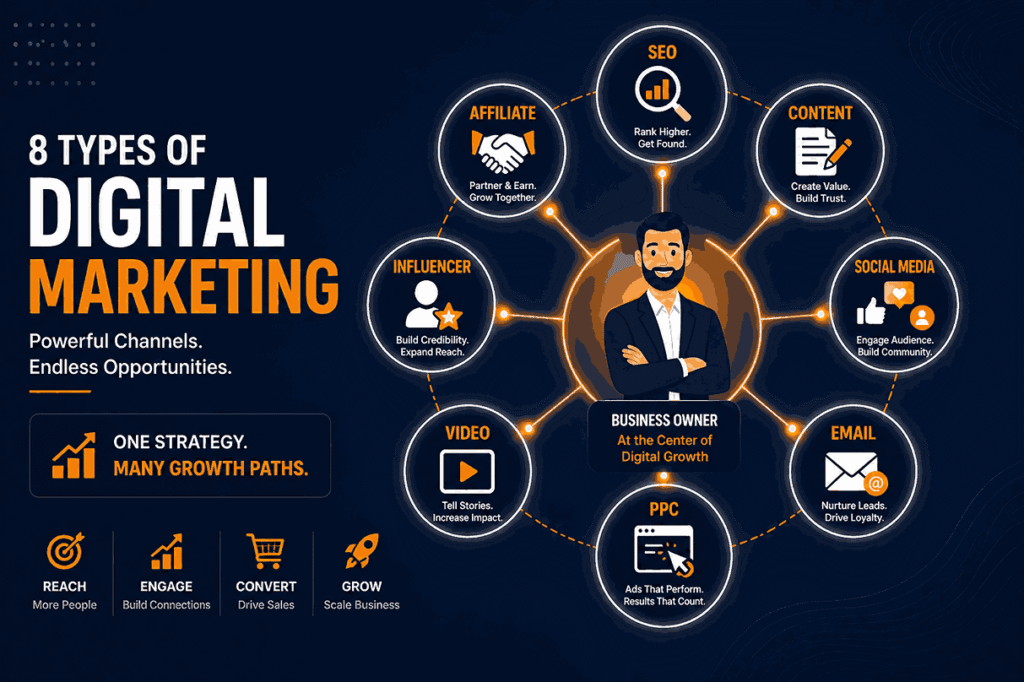
A bold illustration showing a business owner at the center connected to the eight key types of digital marketing channels.
Why Businesses Need to Understand the Different Types of Digital Marketing
Before we dive into each type, let’s establish something important: not every type of digital marketing is right for every business.
A local dental clinic in Pune doesn’t need the same digital marketing mix as a D2C fashion brand targeting pan-India millennials. A B2B software company in Bengaluru needs a completely different approach than a restaurant in Delhi. Each of the Types of Digital Marketing serves a unique purpose. Learning the Types of Digital Marketing is essential for building a strong foundation.
The businesses that waste money on digital marketing almost always make the same mistake — they pick a channel because “everyone is doing it,” not because it aligns with their audience, goals, or business model. The Types of Digital Marketing continue to evolve with new technologies.
Understanding the full spectrum of types of digital marketing gives you the strategic clarity to choose what actually fits — and skip what doesn’t.
With that foundation in place, let’s explore each type in depth.
The 10 Most Important Types of Digital Marketing for Businesses in 2026
Type 1 — Search Engine Optimization (SEO)
If there’s one type of digital marketing that every business with a website should invest in, it’s SEO.
Search Engine Optimization is the process of optimizing your website and its content so that it appears higher in organic (unpaid) search engine results — primarily on Google, which handles over 90% of global search queries.
When a potential customer types “best CA firm in Mumbai” or “affordable wedding photographer in Jaipur” into Google, the businesses that appear on the first page aren’t there by luck. They’re there because of deliberate, strategic SEO. The Types of Digital Marketing are designed to target users across different platforms. Knowing the Types of Digital Marketing helps in choosing the right approach.
Here’s why SEO is one of the most powerful types of digital marketing for businesses:
It captures high-intent traffic — People searching on Google are actively looking for what you offer. They’re not casually scrolling. They want a solution right now.
It delivers compounding returns — Unlike paid ads that stop working the moment you stop paying, a well-ranked page continues to drive traffic month after month, year after year.
It builds credibility — Consumers inherently trust organic search results more than paid ads. Appearing on page one signals authority.
Key components of SEO for businesses:
Keyword research — Finding what your customers actually search for
On-page optimization — Content structure, headings, meta tags, and internal links
Technical SEO — Site speed, mobile responsiveness, and crawlability
Link building — Earning backlinks from authoritative websites in your industry
Local SEO — Optimizing for location-based searches (critical for businesses with physical locations)
Real-world example: A boutique law firm in Chennai began publishing detailed blog posts answering common legal questions their clients asked — things like “how to register a private limited company in India” and “what is the process for trademark registration.” Within 12 months, they were ranking on page one for over 40 keywords and receiving 15–20 qualified inquiries per month — entirely from organic search, with zero ad spend. A clear understanding of the Types of Digital Marketing can simplify decision-making.
Type 2 — Content Marketing
Content marketing is often called the backbone of digital marketing — and for good reason. It powers SEO, fuels social media, drives email engagement, and builds the brand trust that makes every other channel more effective.
At its core, content marketing means creating and distributing valuable, relevant content — blogs, videos, infographics, guides, podcasts, case studies — that attracts your target business audience and positions your brand as the authority in your space. The Types of Digital Marketing include both organic and paid strategies.
The key word is valuable. Content marketing isn’t about creating promotional material about your products. It’s about genuinely helping your audience — answering their questions, solving their problems, and guiding their decisions. Businesses often combine multiple Types of Digital Marketing for better results. The Types of Digital Marketing allow brands to connect with their audience effectively.
Why it works for businesses:
It builds long-term organic traffic through SEO
It nurtures prospects through long sales cycles (especially critical for B2B businesses)
It establishes thought leadership and brand authority
It creates evergreen assets that deliver value for years
Content formats that work best for businesses in 2026:
Long-form blog posts and guides (like this one)
Case studies and success stories
How-to videos and tutorials
Webinars and virtual workshops
Infographics and data visualizations
Industry reports and original research
Podcasts and audio content
A story that illustrates this perfectly:
Ritu runs an HR consultancy in Hyderabad that helps mid-sized companies with hiring and compliance. She started publishing a weekly LinkedIn newsletter addressing common HR challenges — things like “how to handle moonlighting policies” and “what Indian companies get wrong about POSH compliance.”
She never pitched her services directly. She just consistently delivered genuine value. Within eight months, her newsletter had grown to 4,200 subscribers — almost all of them HR managers and business owners, her exact target clients. Three of her five biggest contracts that year came from newsletter readers. Exploring the Types of Digital Marketing can open new growth opportunities.
Social media marketing is one of the most visible types of digital marketing — and for businesses, it offers something no other channel can quite replicate: the ability to build genuine, ongoing relationships with an audience at scale.
Social media marketing involves creating and distributing content on platforms like Instagram, LinkedIn, Facebook, YouTube, X (formerly Twitter), and Pinterest to build brand awareness, engage your audience, and drive business outcomes.
But here’s what separates effective social media marketing from just “being on social media” — it requires strategy, consistency, and platform-specific understanding.
Choosing the right platform for your business:
Platform
Best Business Use Case
Primary Content Type
Instagram
Consumer brands, retail, food, fashion, beauty
Reels, carousels, stories
LinkedIn
B2B services, recruitment, professional services
Articles, posts, thought leadership
YouTube
Education, tutorials, product demos, reviews
Long-form and short-form video
Facebook
Local businesses, community, events, ads
Posts, groups, events
X (Twitter)
Tech, media, real-time engagement, PR
Short-form text, threads
Pinterest
Home décor, fashion, food, lifestyle
Pins, idea boards
Organic vs. Paid Social Media:
Organic social media — free content you publish to build audience and engagement over time — is about playing the long game. It builds community, trust, and brand personality.
Paid social media advertising — boosted posts and targeted ad campaigns — allows you to reach precise audiences based on demographics, interests, behaviors, and location. Meta Ads (Facebook and Instagram) in particular offer some of the most sophisticated targeting available in digital marketing today.
The most effective business social media strategies combine both: organic content to nurture the existing audience, paid ads to grow it.
Type 4 — Email Marketing
Ask any experienced digital marketer what they wish they’d started earlier in their business, and almost all of them will say the same thing: building an email list.
Email marketing remains one of the highest-ROI types of digital marketing available to businesses. Industry benchmarks consistently show returns of $36–$42 for every $1 invested — a figure that no other channel reliably matches.
Why? Because your email list is an audience you own. No algorithm controls who sees your message. No platform change can wipe out your reach overnight. When you send an email, it lands directly in someone’s inbox — one of the most intentional digital spaces they occupy.
The building blocks of effective email marketing for businesses:
Lead magnets — Valuable free resources (guides, templates, checklists, discounts) that incentivize email signups
Welcome sequences — Automated emails that introduce new subscribers to your brand, build trust, and set expectations
Newsletters — Regular, value-packed communications that keep your audience engaged and your brand top-of-mind
Promotional campaigns — Targeted offers sent to the right segments at the right time
Automation and triggers — Behavior-based email sequences (e.g., someone downloads a case study → receives a relevant follow-up email series)
For B2B businesses especially, email marketing is invaluable. Complex, high-value purchasing decisions take time. A well-structured email nurture sequence can keep your brand in consideration across a 3–6 month sales cycle — without requiring constant manual outreach.
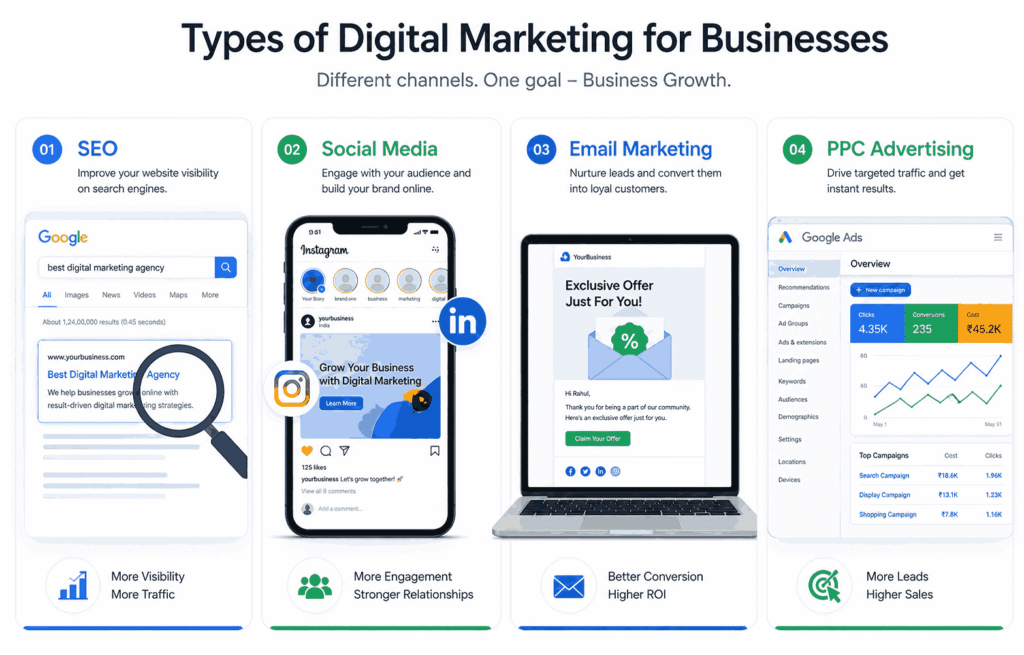
A clean split-panel illustration showcasing four key digital marketing channels used by businesses for growth and engagement.
Type 5 — Pay-Per-Click Advertising (PPC)
When businesses need results fast — a product launch, a seasonal campaign, a lead generation push — PPC is the accelerant.
Pay-Per-Click advertising is a paid digital marketing model where businesses pay only when a user clicks their ad. Google Ads is the dominant PPC platform, but Meta Ads (Facebook and Instagram), LinkedIn Ads, and YouTube Ads are equally important depending on your business type.
Why PPC is essential for businesses:
Immediate visibility — Unlike SEO, which builds over months, a well-configured PPC campaign can put your business at the top of Google search results within hours.
Precise targeting — Show your ads only to people in specific locations, age groups, interests, income brackets, or at specific times of day.
Pay for performance — You only pay when someone engages with your ad, making budget allocation measurable and efficient.
Full control — Set daily budgets, pause campaigns instantly, and adjust targeting in real time.
The main PPC channels for businesses:
Google Search Ads — Text ads that appear when someone searches for keywords relevant to your business. Ideal for capturing high-intent buyers who are actively searching for your product or service.
Google Display Ads — Visual banner ads that appear across millions of websites in Google’s Display Network. Great for brand awareness and retargeting.
Meta Ads (Facebook & Instagram) — Highly visual ads targeting users based on detailed demographic and behavioral data. Powerful for consumer businesses and retargeting campaigns.
LinkedIn Ads — Professional targeting by job title, industry, company size, and seniority. Expensive per click, but unmatched for reaching B2B decision-makers.
YouTube Ads — Video ads that appear before or during YouTube content. Excellent for brand storytelling and product demonstrations.
The critical rule of PPC for businesses: Paid ads amplify what’s already working — they don’t fix a broken offer or a poorly converting website. Before investing significantly in PPC, ensure your website is optimized to convert the traffic you’re paying for. Each of the Types of Digital Marketing has its own advantages and use cases. The Types of Digital Marketing help businesses adapt to changing consumer behavior.
Type 6 — Video Marketing
Video has become the dominant content consumption format on the internet — and its growth shows no signs of slowing down.
Over 91% of businesses now report using video as a marketing tool, according to Wyzowl’s annual research. And in the Indian market specifically, where YouTube is the second-most visited website and short-form video consumption on Instagram and YouTube Shorts has exploded, video marketing is no longer a “nice to have” for businesses — it’s a core channel. The Types of Digital Marketing provide flexibility in how brands communicate.
Types of video content that work for businesses:
Product demonstrations — Show your product in action, overcoming objections visually
Customer testimonials and case studies — Real customers sharing real results (the most persuasive content type)
Educational tutorials — Teaching your audience something valuable while positioning your brand as the expert
Behind-the-scenes content — Building authenticity and human connection with your brand
Explainer videos — Clarifying complex products, services, or processes in 60–90 seconds
Live videos and webinars — Real-time engagement that builds community and drives conversions
The opportunity for Indian businesses specifically: Many business categories in India are still producing very little video content. A plumbing company that posts weekly “how to fix common household plumbing issues” videos on YouTube can dominate local search and build an audience of potential customers at almost zero cost — simply because no competitor is doing it.
Influencer marketing has matured from a celebrity endorsement model into a sophisticated, data-driven discipline — and for many businesses, it’s now one of the most effective types of digital marketing available.
Influencer marketing involves partnering with individuals who have established, engaged audiences on social media to promote your products or services in an authentic, credible way. The Types of Digital Marketing are essential for creating effective campaigns. Many strategies are built using a mix of Types of Digital Marketing.
The key evolution in recent years: micro-influencers and nano-influencers have overtaken mega-celebrities in terms of marketing effectiveness for most businesses. The Types of Digital Marketing help businesses stay competitive in the market.
Here’s why: A fitness influencer with 40,000 followers who posts genuinely about health and nutrition has a deeply engaged, trusting audience. When they recommend a protein supplement or a fitness app, their followers take notice — because they trust this person, not because they’re being paid to watch an ad.
Influencer tiers and what they mean for businesses:
Tier
Follower Range
Best For
Nano-influencers
1,000 – 10,000
Hyperlocal, community-specific campaigns
Micro-influencers
10,000 – 100,000
Niche targeting, high engagement, cost-effective
Mid-tier influencers
100,000 – 500,000
Broader reach with reasonable engagement
Macro-influencers
500,000 – 1M
Mass brand awareness
Celebrity/Mega
1M+
Maximum reach, lowest engagement rate
For most small and mid-sized Indian businesses, micro and nano-influencer partnerships — particularly in regional languages and specific geographic markets — offer the best combination of relevance, authenticity, and ROI.
Type 8 — Affiliate Marketing
Affiliate marketing is the performance-based type of digital marketing where businesses pay external partners (affiliates) a commission for driving traffic or sales through their unique referral links.
Think of it as building a distributed sales force that only gets paid when it delivers results. For businesses, this means extended reach without upfront advertising spend.
How it works for businesses:
A business creates an affiliate program with defined commission rates
Affiliates (bloggers, content creators, comparison sites, influencers) sign up and receive unique tracking links
Affiliates promote the business’s products through their channels
When a sale or lead is generated through their link, the affiliate earns a commission
Affiliate marketing works exceptionally well for e-commerce businesses, SaaS companies, financial products, and online education brands. In India, platforms like vCommission, cuelinks, and individual brand affiliate programs are actively used by thousands of businesses.
Type 9 — WhatsApp and Mobile Marketing
In the Indian business context specifically, this type of digital marketing deserves its own dedicated section — because India’s relationship with WhatsApp is unlike any other country in the world.
With over 500 million active WhatsApp users in India, and a culture of doing business, sharing recommendations, and making purchase decisions through WhatsApp, this platform represents a uniquely powerful marketing channel for Indian businesses.
WhatsApp Business marketing tactics:
Broadcast lists for promotional messages and offers
Product catalogues showcasing your range directly in the app
Automated responses for common customer inquiries
Order confirmations, shipping updates, and post-purchase communication
Click-to-WhatsApp ads (Meta Ads that take users directly to a WhatsApp conversation)
Beyond WhatsApp, SMS marketing remains highly effective in India for transactional messages, OTP-based communications, and promotional alerts — with open rates that dwarf most other channels.
Mobile marketing more broadly — designing every customer touchpoint for the mobile-first Indian user — is not a separate strategy so much as a lens through which all other types of digital marketing should be applied.
Type 10 — Search Engine Marketing (SEM) and Remarketing
While SEM is technically the umbrella term that covers both SEO and paid search advertising, in practice most marketers use it to refer specifically to paid search — Google Ads and Bing Ads campaigns that appear in search results.
Remarketing (or retargeting) deserves special mention as a particularly powerful tactic for businesses. It involves showing targeted ads to people who have already visited your website or interacted with your brand — but haven’t converted yet.
Consider this: research consistently shows that 95–98% of first-time website visitors leave without taking action. Remarketing allows you to re-engage that majority — showing them relevant ads as they browse other websites, use social media, or watch YouTube videos — keeping your brand top-of-mind until they’re ready to convert.
For businesses with longer purchase decision cycles, remarketing is not optional — it’s essential.
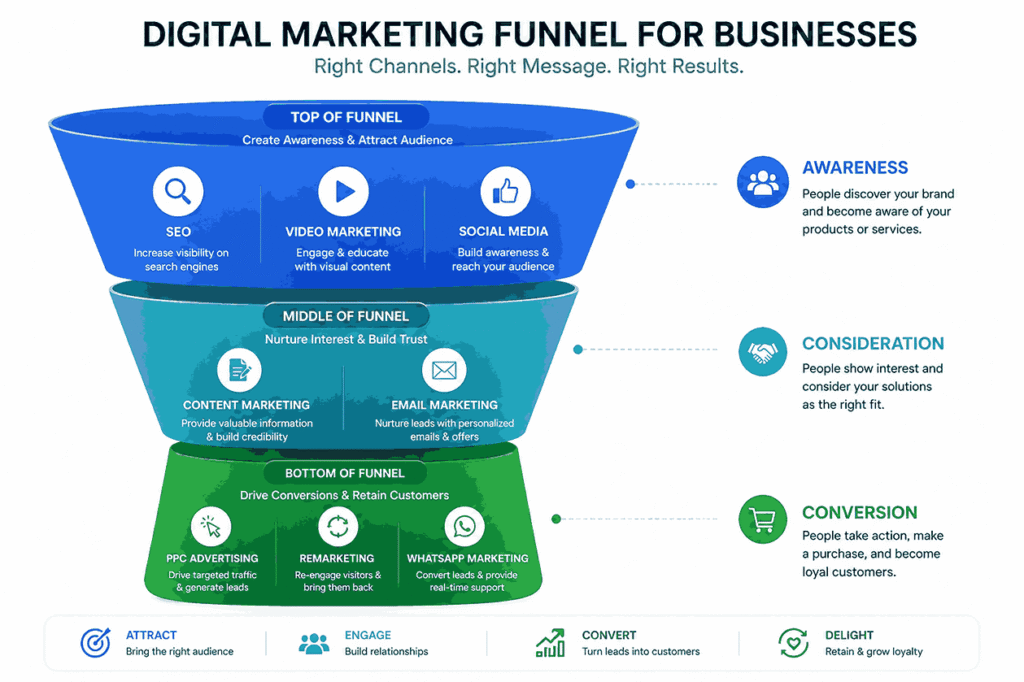
A clean funnel diagram mapping digital marketing channels to awareness, consideration, and conversion stages for businesses.
How to Choose the Right Types of Digital Marketing for Your Business
With 10 types on the table, the natural question is: where do I start?
Here’s a practical decision framework for businesses:
Step 1 — Define your primary business goal Are you trying to build brand awareness, generate leads, drive e-commerce sales, or retain existing customers? Your goal determines your channel priority.
Step 2 — Know where your audience spends time online A B2B CFO making a software purchasing decision lives on LinkedIn and Google. A 22-year-old fashion buyer discovers brands on Instagram and YouTube. Match your channels to your audience — not to trends.
Step 3 — Consider your timeline
Need results in 30–60 days? → PPC, WhatsApp marketing, Meta Ads
Building for 6–12 months out? → SEO, Content Marketing, Email list building
Long-term brand equity? → All organic channels combined
Step 4 — Assess your resources honestly Some types of digital marketing require more budget (PPC, influencer partnerships). Others require more time and skill (SEO, content marketing, video). Match your channel choices to your actual available resources.
Step 5 — Start with 2–3 channels, not 10 The biggest mistake businesses make is trying to be everywhere at once. Pick two or three types of digital marketing that best fit your audience, goal, and resources. Execute them consistently. Measure results. Expand from a position of strength.
Conclusion: Choosing the Right Types of Digital Marketing Can Transform Your Business
Let’s bring everything together.
The types of digital marketing available to businesses in 2026 form a powerful, interconnected ecosystem. Each type serves a specific purpose, reaches a specific audience at a specific stage of their decision journey, and contributes to business growth in a distinct way.
Here’s a quick recap of all 10 types we covered:
SEO — Long-term organic visibility on Google and search engines
Content Marketing — Building trust and authority through valuable content
Social Media Marketing — Engaging audiences where they spend their time
Email Marketing — Owning your audience and nurturing them to conversion
PPC Advertising — Paid campaigns for immediate, targeted visibility
Video Marketing — The most engaging content format for modern audiences
Influencer Marketing — Leveraging trusted voices to reach niche audiences
WhatsApp & Mobile Marketing — India’s most direct digital communication channel
SEM & Remarketing — Capturing high-intent buyers and re-engaging lost visitors
The businesses that grow most consistently aren’t those that use the most channels — they’re the ones that choose the right channels for their specific audience and goals, and execute them with discipline and consistency.
Your competitors are already using some of these types of digital marketing. The question is — are they using them strategically? And more importantly, are you?
🚀 Ready to Build a Digital Marketing Strategy That Actually Works for Your Business?
You’ve done the hard part — you’ve educated yourself on the full landscape. Now it’s time to act.
👉 Take one concrete action this week. Audit your current digital marketing mix. Are you on the right channels for your audience? Are you missing a type that could unlock a new growth lever? Pick one improvement and implement it this week with 18 Media Advertising.
The businesses that win digitally aren’t the ones that know the most. They’re the ones that act on what they know. Start today. Connect with 18 Media Advertising for FREE Consultation.
Frequently Asked Questions About Types of Digital Marketing for Businesses
Q1: What are the most important types of digital marketing for small businesses with limited budgets? For small businesses with tight budgets, the highest-priority types of digital marketing are SEO, content marketing, and social media marketing — all of which can be executed with minimal financial investment, primarily requiring time and consistency. Google Business Profile optimization is also essential and completely free. Once a budget becomes available, targeted PPC campaigns and email marketing with a strong lead magnet offer the best paid ROI for small businesses.
Q2: Which types of digital marketing work best for B2B businesses specifically? B2B businesses typically see the strongest results from SEO (particularly for informational and commercial intent keywords), content marketing (blog posts, case studies, white papers, and webinars), LinkedIn marketing (both organic content and paid ads), and email marketing for nurturing long sales cycles. These channels align with how B2B buyers actually research and evaluate vendors — through search, education, and peer validation — rather than through impulse-driven social media discovery.
Q3: How many types of digital marketing should a business use simultaneously? There’s no single right answer, but for most businesses — especially those just getting started — focusing on 2–3 types of digital marketing and executing them well is significantly more effective than trying to manage 6–8 channels at once. As skills develop, data accumulates, and resources grow, additional channels can be added strategically. Quality of execution always beats quantity of channels.
Q4: Are all types of digital marketing relevant for local Indian businesses, or only some? Not all types are equally relevant for every local business. For a local Indian business — a clinic, salon, coaching center, or retail shop — the highest-priority types of digital marketing are typically local SEO and Google Business Profile optimization, WhatsApp Business marketing, Facebook and Instagram (organic and paid), and Google Ads with hyperlocal targeting. Video marketing on Instagram Reels and YouTube can also be surprisingly effective for local businesses without large competitors. Affiliate marketing and programmatic advertising are typically lower priority until the business has established its core digital presence.
Q5: What is the difference between inbound and outbound types of digital marketing? Inbound digital marketing refers to types that attract customers to you — SEO, content marketing, social media, and email marketing to an opted-in list. Customers come to you because you’ve created something valuable that pulled them in. Outbound digital marketing refers to types where you push your message out to an audience — PPC ads, display advertising, cold email, and most social media paid advertising. The most effective business digital marketing strategies combine both: inbound channels to build long-term organic audience and authority, outbound channels to accelerate reach and capture high-intent buyers immediately.