Introduction: What If You Built a Shop and Nobody Came?
Imagine spending months setting up the perfect business. Your product is excellent. Your pricing is competitive. Your branding looks sharp. But weeks after launching — silence. No visitors, no inquiries, no sales.
This isn’t a rare story. It happens every day to businesses that haven’t yet understood the fundamentals of digital marketing.
In a world where over 5.4 billion people are online, the gap between businesses that grow and businesses that struggle often comes down to one thing — do they know how to reach their audience digitally?
This guide is designed to change that for you.
Whether you’re a complete beginner, a small business owner, a student exploring a career path, or an entrepreneur ready to scale — this is your definitive starting point. We’ll walk through every core concept, channel, and strategy that makes digital marketing work, explained in plain, practical language.
Let’s build your foundation — brick by brick.
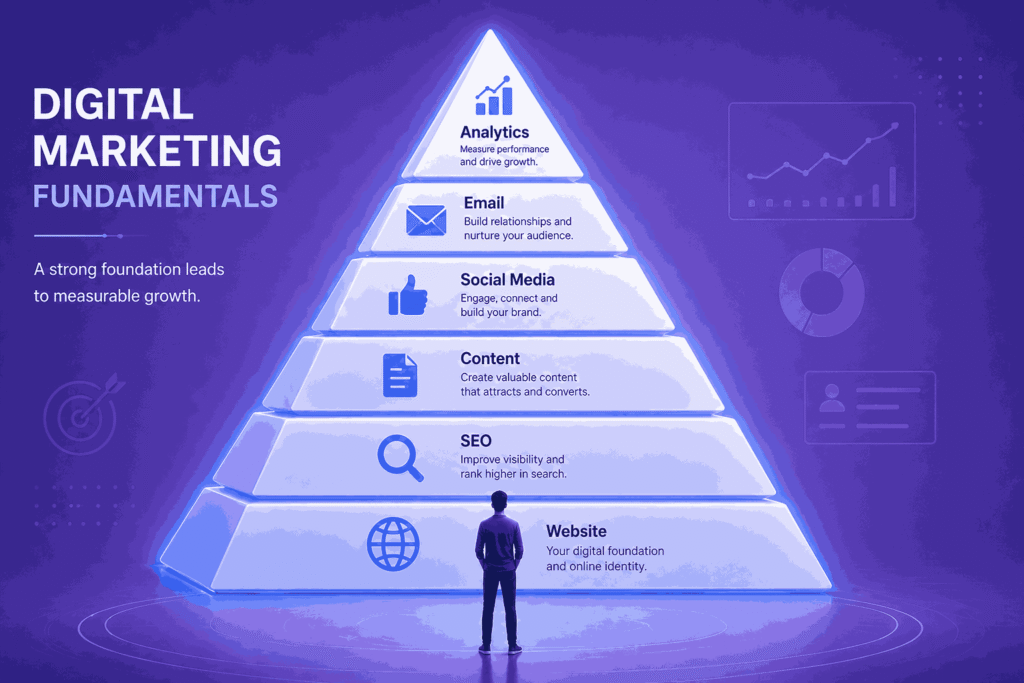
A modern illustration depicting the core fundamentals of digital marketing structured as a pyramid, highlighting key elements from website to analytics.
What Are the Fundamentals of Digital Marketing?
Before diving into tactics and tools, it’s worth grounding ourselves in what “fundamentals” actually means in this context.
The fundamentals of digital marketing are the core principles, channels, and practices that form the foundation of every successful online marketing strategy. They’re not trends that come and go. They’re the building blocks that remain relevant regardless of which platform is currently popular or which algorithm just changed.
Think of them the way you’d think of grammar in writing. Trends change — slang evolves, styles shift — but the underlying grammar holds everything together. Digital marketing fundamentals work the same way.
Master these, and you’ll be able to adapt to any new platform, tool, or technology that emerges — because you’ll understand the why behind everything.
The Core Question Every Digital Marketer Must Answer
Before any strategy, channel, or campaign — every effective digital marketer starts by answering four fundamental questions:
Who am I trying to reach? (Target audience)
What do I want them to do? (Goal or conversion)
Where do they spend their time online? (Channel selection)
How will I measure success? (Analytics and KPIs)
Everything else in digital marketing is a response to these four questions. If you can answer them clearly, you already have more strategic clarity than most beginners — and even many experienced marketers.
Fundamental #1 — Having a Strong Digital Foundation (Your Website)
The Fundamentals of Digital Marketing form the base of every successful strategy. Before you think about any marketing channel, your website needs to be in order. It’s your digital home — the place every channel eventually leads back to.
A website that’s slow, confusing, or poorly designed will undo even the best marketing. Visitors will leave within seconds, and all your effort will be wasted.
Here’s what a strong digital foundation looks like:
Fast loading speed — Pages should load in under 3 seconds. Google research shows that 53% of mobile visitors abandon a page that takes longer than 3 seconds to load.
Mobile responsiveness — Over 60% of global web traffic comes from mobile devices. Your website must look and work perfectly on a phone screen.
Clear navigation — Visitors should instantly know who you are, what you offer, and what action to take next.
Strong calls-to-action (CTAs) — Every page should guide the visitor toward a specific next step — whether that’s making a purchase, booking a call, or subscribing.
SSL security — An HTTPS website (indicated by the padlock icon) builds trust with visitors and is favored by Google in rankings.
Think of your website as your best salesperson — available 24 hours a day, 7 days a week, never taking a sick day. Invest in making it work properly before investing in any traffic channel.
Fundamental #2 — Search Engine Optimization (SEO)
Beginners should start by learning the Fundamentals of Digital Marketing. If your website is your home, SEO is the address that helps people find it.
Search Engine Optimization is the practice of improving your website’s content, structure, and authority so it ranks higher in search engine results — primarily Google, which handles over 90% of global search traffic.
When someone searches “best accounting software for small businesses” and your page appears in the top three results, that’s the result of strong SEO. And unlike paid ads, that traffic costs you nothing per click.
The Three Pillars of SEO
On-Page SEO — Everything you control directly on your website:
Using the right keywords in your content, headings, and meta tags
Writing helpful, well-structured content that answers real questions
Optimizing images with descriptive file names and alt text
Ensuring proper internal linking between related pages
Off-Page SEO — Building your website’s authority and credibility:
Earning backlinks from other reputable websites
Getting brand mentions across the web
Building a strong presence on Google Business Profile for local searches
Technical SEO — The behind-the-scenes elements:
Site speed and Core Web Vitals
XML sitemaps and robot.txt configuration
Structured data and schema markup
Fixing broken links and crawl errors
SEO is one of the most foundational skills in digital marketing. It takes time to show results — typically 3–6 months — but once momentum builds, it delivers consistent, compounding traffic without ongoing ad spend.
Fundamental #3 — Content Marketing
A clear grasp of the Fundamentals of Digital Marketing helps in long-term growth. Here’s a truth that sits at the heart of the fundamentals of digital marketing: nobody wants to be sold to — but everyone wants their problems solved.
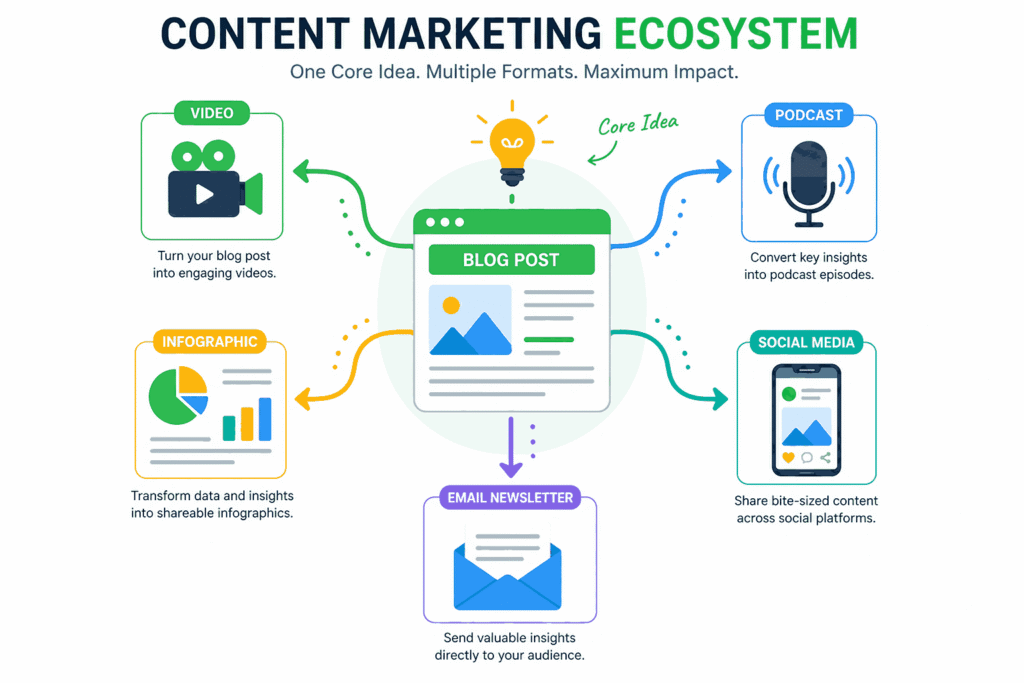
Content marketing is the discipline of creating and distributing genuinely useful content — blog posts, videos, infographics, podcasts, guides — that attracts your target audience by helping them, not interrupting them.
Why Content Marketing Works
The Fundamentals of Digital Marketing are easier to understand than they seem. When you consistently answer your audience’s questions through content, three powerful things happen:
You attract organic search traffic — Google rewards pages that genuinely help searchers.
You build trust and authority — Audiences who learn from you are far more likely to buy from you.
You create long-term assets — A great blog post published today can drive traffic for years.
Real-world example: Mint, the personal finance app, built a blog that became one of the most visited personal finance resources on the internet — before most people even knew what the Mint app was. By helping people understand budgeting and saving, they built an audience that naturally converted into users. That’s content marketing in its most powerful form.
The most effective types of content in 2026 include:
Long-form SEO blog posts and guides
Short-form and long-form video content
Infographics and visual explainers
Podcasts and audio content
Free tools, templates, and downloadable resources
A modern infographic illustrating how a single blog post can be repurposed into multiple content formats across digital marketing channels.
Fundamental #4 — Social Media Marketing
It’s important to know that Social media comes as 4th Fundamentals of Digital Marketing. Social media has fundamentally changed how brands communicate with their audiences, and understanding it is a non-negotiable part of mastering the fundamentals of digital marketing.
But here’s what most beginners get wrong: they treat all social media platforms as the same. They’re not. Each platform has its own culture, content format, and audience expectations.
Here’s a quick breakdown:
Platform
Best For
Content Type
Instagram
Visual brands, lifestyle, products
Reels, stories, carousels
LinkedIn
B2B, professionals, thought leadership
Articles, posts, short videos
YouTube
Education, tutorials, reviews
Long-form and short-form video
Facebook
Community building, local business, ads
Posts, groups, events
X (Twitter)
Real-time news, brand voice, networking
Short text, threads
Pinterest
DIY, fashion, food, home décor
Pins, idea boards
Organic vs. Paid Social Media
Organic social media means your regular, unpaid content — posts, stories, reels, and community engagement. It builds brand awareness, trust, and audience relationships over time.
Paid social media means running targeted advertisements to reach specific audiences based on demographics, interests, behaviors, and location. Platforms like Facebook and Instagram offer remarkably precise targeting — you can literally show an ad only to 28–35-year-old women in Mumbai who are interested in fitness and have recently searched for protein supplements.
A well-rounded social media strategy uses both — organic content to build the relationship, paid ads to accelerate reach and conversions.
Fundamental #5 — Email Marketing
The Fundamentals of Digital Marketing guide how businesses grow online. And email marketing is one of them. Many professionals begin with the Fundamentals of Digital Marketing. If social media is rented land — subject to algorithm changes, platform shutdowns, and policies you can’t control — then your email list is property you truly own.
Email marketing is the practice of building a list of subscribers who have opted in to receive communications from you, and then nurturing those subscribers through valuable, relevant emails.
It’s one of the oldest digital marketing channels — and consistently one of the most effective. Industry benchmarks place email marketing ROI at approximately $36–$42 per $1 spent, outperforming nearly every other digital channel. The Fundamentals of Digital Marketing are the backbone of online success.
The Building Blocks of Effective Email Marketing
Lead magnets — Something valuable you offer for free in exchange for an email address (a guide, a checklist, a discount, a mini-course)
Welcome sequence — A series of emails that introduce new subscribers to your brand, build trust, and set expectations
Regular newsletters — Consistent communication that keeps your audience engaged and informed
Promotional campaigns — Targeted offers sent to segmented audiences at the right time
Automation — Triggered email sequences based on subscriber behavior (opened a specific email, clicked a link, made a purchase)
The most important principle in email marketing: earn the inbox. Every email you send should deliver enough value that your subscriber is glad they opened it. Do that consistently, and email becomes your most powerful revenue channel.
Fundamental #6 — Paid Advertising (PPC and Beyond)
Organic channels like SEO and content marketing are powerful — but they take time. Paid advertising gives you the ability to accelerate results and reach your target audience almost immediately.
Pay-Per-Click (PPC) advertising is the most common form of paid digital marketing. You bid on keywords or audience segments, your ad is shown to relevant users, and you pay only when someone clicks.
The main PPC platforms include:
Google Ads — Appear in search results when someone searches your keywords. Ideal for capturing high-intent buyers who are actively looking.
Meta Ads (Facebook & Instagram) — Reach audiences based on detailed demographic and interest targeting. Excellent for awareness and retargeting.
LinkedIn Ads — Reach professionals by job title, industry, company size, and seniority. Powerful for B2B marketing.
YouTube Ads — Video ads shown before or during YouTube content. Highly engaging and increasingly effective.
The Golden Rule of Paid Advertising
Paid ads amplify what’s already working — they don’t fix what’s broken. If your website doesn’t convert visitors well, or your offer isn’t compelling, no amount of ad spend will fix that. Always get your foundation right first. Without the Fundamentals of Digital Marketing, strategies can feel confusing.
Fundamental #7 — Analytics and Data Interpretation
Here’s where the fundamentals of digital marketing truly separate the professionals from the guessers.
Digital analytics is the practice of tracking, measuring, and interpreting the data generated by your marketing activities — and using it to make better decisions.
Without analytics, digital marketing is just expensive guessing. With analytics, every campaign becomes a learning opportunity that makes the next one smarter and more effective.
The goal of analytics isn’t to drown in data — it’s to identify what’s working, what isn’t, and where to focus your energy next. Start with a few key metrics, understand them deeply, and build from there. The Fundamentals of Digital Marketing help simplify complex concepts.
Fundamental #8 — Understanding the Customer Journey
Every purchase decision is a journey. Someone doesn’t just randomly decide to buy your product out of thin air. They go through a process — from first awareness of a problem, to researching solutions, to evaluating options, to finally making a decision.
Understanding this journey is central to the fundamentals of digital marketing, because different marketing tactics work best at different stages.
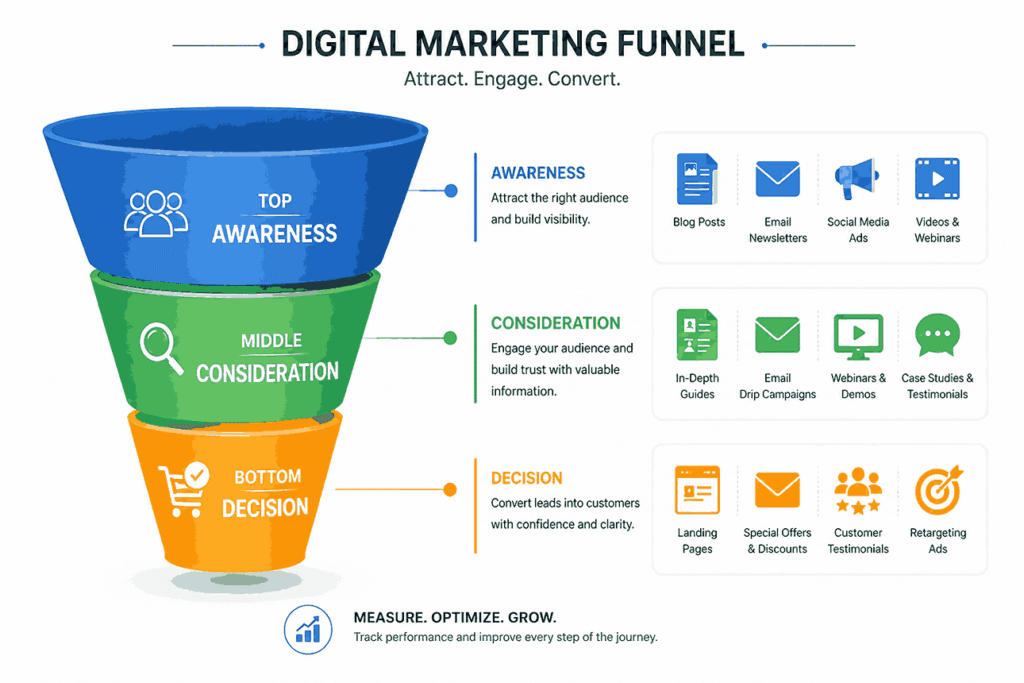
The classic framework is the Marketing Funnel:
Top of Funnel (Awareness) — The customer realizes they have a problem or need. They’re not ready to buy. They need to be educated. → Best channels: SEO blog content, social media, YouTube videos, podcast appearances
Middle of Funnel (Consideration) — They’re actively researching solutions and comparing options. They know your brand exists and are weighing it against alternatives. → Best channels: Email nurture sequences, case studies, webinars, comparison content, retargeting ads
Bottom of Funnel (Decision) — They’re ready to buy. They just need the final nudge — the right offer, social proof, or guarantee. → Best channels: Testimonials, demos, free trials, limited-time offers, retargeting campaigns
When you map your marketing tactics to the right stage of the customer journey, everything becomes more intentional — and more effective. The Fundamentals of Digital Marketing apply to businesses of all sizes.
A clean and modern funnel infographic illustrating the three key stages of digital marketing: awareness, consideration, and decision.
Putting the Fundamentals of Digital Marketing Together: A Real-World Scenario
Let’s see how all eight fundamentals work together in practice.
Meet Kavya. She’s launching an online store selling handcrafted leather bags from Kolkata.
Here’s how she applies the fundamentals of digital marketing:
Website — She builds a fast, mobile-optimized e-commerce site with clear product pages and an easy checkout process.
SEO — She researches keywords like “handcrafted leather bags India” and optimizes her product pages and blog content around them.
Content Marketing — She writes blog posts on “how to care for genuine leather” and “what makes handcrafted bags special” — attracting organic traffic from people interested in leather goods.
Social Media — She posts behind-the-scenes crafting videos on Instagram Reels and curated product photos, growing a community of leather enthusiasts.
Email Marketing — She offers a 10% first-order discount in exchange for an email subscription, then nurtures subscribers with styling tips and new product launches.
Paid Ads — She runs a small Google Shopping campaign targeting high-intent searches like “buy leather tote bag online.”
Analytics — She tracks which blog posts bring the most traffic, which ads deliver the lowest cost-per-purchase, and which emails get the highest open rates.
Customer Journey Mapping — She creates content for every stage — awareness blogs, consideration-stage emails, and decision-stage retargeting ads.
Six months in, Kavya has a growing organic audience, a loyal email list, and a profitable paid ads channel. She didn’t get lucky — she built on a solid foundation of fundamentals. To build expertise, focus on the Fundamentals of Digital Marketing first.
Conclusion: The Fundamentals of Digital Marketing Are Your Greatest Asset
Let’s bring everything together.
The fundamentals of digital marketing aren’t glamorous. They’re not the trending topic of the week or the newest social media feature. To succeed online, understanding the Fundamentals of Digital Marketing is essential. But they are the reason some businesses scale consistently while others spin their wheels chasing the next shiny object. The Fundamentals of Digital Marketing are key to building effective campaigns.
Here’s a quick recap of everything we covered:
Your Website — The foundation everything else is built on
SEO — Making sure the right people can find you on Google
Content Marketing — Attracting and educating your audience through valuable content
Social Media Marketing — Building relationships where your audience already spends time
Email Marketing — Owning your audience and nurturing them toward a decision
Paid Advertising — Accelerating results with precision-targeted campaigns
Analytics — Making data-driven decisions instead of guessing
Customer Journey — Mapping the right message to the right person at the right moment
These eight fundamentals form a complete system. A strong foundation comes from mastering the Fundamentals of Digital Marketing. You don’t need to implement all eight overnight — but understanding how they connect is what separates a reactive marketer from a strategic one.
Every marketer should revisit the Fundamentals of Digital Marketing regularly. The businesses that will thrive in 2026 and beyond won’t be the ones who chased every trend. They’ll be the ones who mastered the fundamentals and executed them consistently. The Fundamentals of Digital Marketing support consistent and scalable growth.
You now have the roadmap. What you do with it is up to you.
🚀 Take Your First Step — Right Now
Knowledge without action is just information. Here’s how to make this count:
👉 Connect with 18 Media Advertising today and choose the best marketing strategy for your business.
Frequently Asked Questions About the Fundamentals of Digital Marketing
Q1: What exactly are the fundamentals of digital marketing, and why do they matter? The fundamentals of digital marketing are the core principles and channels — including SEO, content marketing, social media, email, paid advertising, and analytics — that form the backbone of any successful online marketing strategy. They matter because they provide a stable framework that remains relevant even as platforms and trends constantly evolve. Businesses that master the fundamentals can adapt to any change with confidence.
Q2: How long does it take to learn the fundamentals of digital marketing? A solid foundational understanding can be built in 4–8 weeks with consistent daily learning — roughly 1–2 hours per day. However, true proficiency comes from hands-on practice over several months. The good news is that you don’t need to master everything before you start. Pick one fundamental, apply it, learn from the results, and then build from there.
Q3: Which fundamental of digital marketing should a complete beginner start with? Most beginners benefit most from starting with either their website foundation or content marketing. A well-structured website gives you a home base for all other efforts, while content marketing teaches you how to think like your audience — which is a skill that improves every other channel you add later. SEO should be introduced early as well, as it compounds over time.
Q4: Are the fundamentals of digital marketing the same for both small businesses and large companies? Yes — the fundamentals are universal. The scale of execution differs, but the underlying principles don’t. A one-person business and a multinational corporation both need to understand their audience, create valuable content, optimize for search, build an email list, and track their results. The tools and budgets may vary — the fundamentals do not.
Q5: Can I apply the fundamentals of digital marketing without a large budget? Absolutely. Many of the most powerful fundamentals — SEO, content marketing, organic social media, and email marketing — can be executed with little to no financial investment. A laptop, a free Google Analytics account, a basic website, and consistent effort are enough to get started. Budget amplifies results, but it’s not a prerequisite for building a strong digital marketing foundation.