Introduction: Why Most Businesses Choose the Wrong Digital Marketing Agency — And How to Get It Right
Here’s a scenario that plays out more often than most business owners would like to admit.
A business owner — frustrated with slow growth and tired of watching competitors pull ahead online — decides it’s finally time to hire a digital marketing agency. They Google a few options, read some websites, hop on a couple of calls, and go with the agency that sounds the most confident and quotes a reasonable price.
Six months later? The results are underwhelming. Traffic has barely moved. Leads haven’t improved. Every monthly report is full of impressions, reach, and engagement numbers — but the revenue needle hasn’t budged.
Sound familiar?
The problem usually isn’t that digital marketing doesn’t work. It’s that the wrong digital marketing agency was chosen for the wrong reasons — without the right questions being asked or the right criteria being applied.
In 2026, the digital marketing agency landscape in India alone has thousands of players — from solo freelancers calling themselves agencies to large full-service firms. Navigating this landscape confidently requires knowing exactly what to look for, what questions to ask, and what red flags to avoid.
That’s precisely what this guide delivers.
Whether you’re hiring a digital marketing agency for the first time, switching from a disappointing previous experience, or simply doing your due diligence before making a significant business investment — this is the guide you need to get it right.
A professional illustration of a business owner collaborating with a digital marketing agency team to drive growth through data-driven strategies.
What Does a Digital Marketing Agency Actually Do?
Before we get into how to choose one, let’s be clear about what a digital marketing agency actually is — and what you should expect it to do for your business.
A digital marketing agency is a company that provides professional marketing services using online channels and digital technologies to help businesses grow their online presence, generate leads, and increase revenue.
But here’s where it gets nuanced — not all digital marketing agencies do the same things. Some are full-service firms handling everything from SEO to paid advertising to social media to content creation. Others specialize deeply in one or two specific areas.
Types of Digital Marketing Agencies
Understanding the different types helps you identify which one fits your specific needs:
Full-Service Digital Marketing Agencies These agencies offer a comprehensive suite of services — SEO, content marketing, social media management, paid advertising, email marketing, web design, and more — all under one roof. They’re best suited for businesses that want a single, integrated marketing partner managing their entire digital presence.
SEO-Focused Agencies These agencies specialize exclusively in search engine optimization — improving organic rankings, driving search traffic, and building domain authority. If search visibility is your primary challenge, a specialist SEO agency may deliver deeper expertise than a generalist firm.
Performance Marketing Agencies These agencies focus specifically on paid digital advertising — Google Ads, Meta Ads, LinkedIn Ads, and programmatic advertising. They’re data-driven, ROI-obsessed, and best suited for businesses that need to scale paid customer acquisition efficiently.
Social Media Marketing Agencies Specializing in content creation, community management, and paid social campaigns, these agencies help brands build and engage audiences on platforms like Instagram, LinkedIn, Facebook, and YouTube.
Content Marketing Agencies These agencies focus on creating high-quality content — blogs, videos, infographics, podcasts, and long-form guides — that drives organic traffic, builds brand authority, and nurtures prospects through the purchase journey.
Niche or Industry-Specific Agencies Some agencies specialize in specific industries — healthcare, real estate, education, e-commerce, B2B technology — and bring deep domain expertise alongside their marketing skills. For businesses in highly specialized sectors, this can be a significant advantage.
Why Hiring the Right Digital Marketing Agency Is One of the Most Important Business Decisions You’ll Make
Let’s be honest about the stakes here.
Hiring a digital marketing agency isn’t like buying office supplies. It’s a strategic partnership that directly impacts your brand reputation, customer acquisition, revenue growth, and competitive position.
Done right, the right digital marketing agency partnership can:
Accelerate your business growth by years compared to in-house efforts
Bring specialist expertise and tools that would cost significantly more to build internally
Free up your time and energy to focus on what you do best — running your business
Provide an external perspective that identifies opportunities and blind spots you can’t see from inside the business
Done wrong, a poor agency relationship can:
Waste significant marketing budget with little to show for it
Damage your brand’s online reputation through poor content or aggressive tactics
Lock you into long contracts while delivering mediocre results
Leave your competitors pulling further ahead while you’re stuck in a frustrating agency relationship
The difference between these two outcomes almost always comes down to how carefully the selection decision was made upfront.
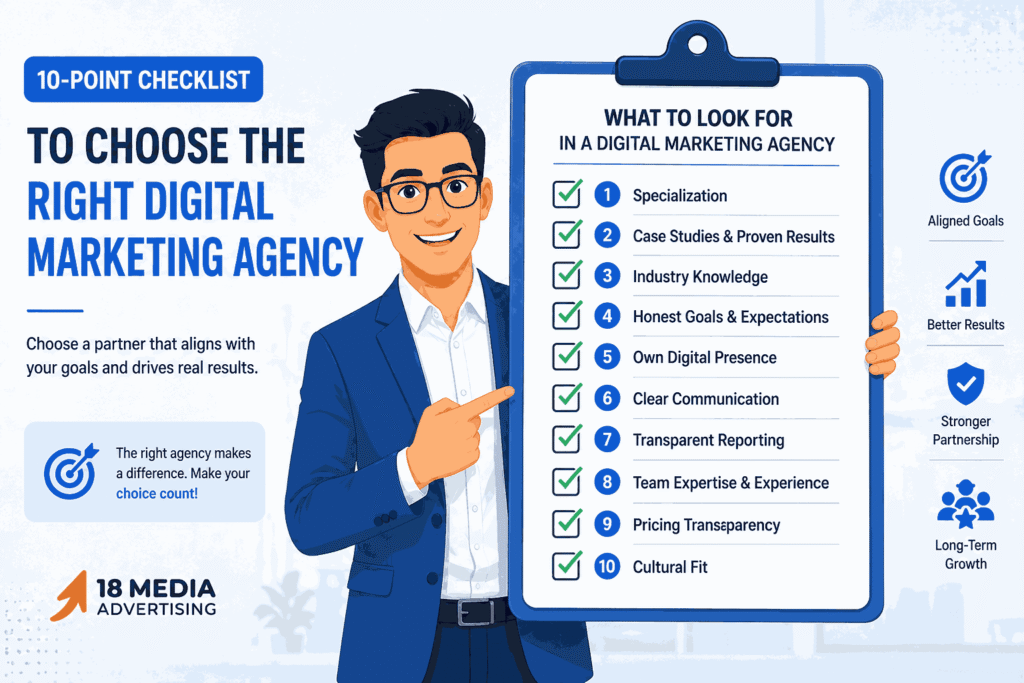
The 10 Criteria for Choosing the Best Digital Marketing Agency for Your Business
Criterion 1 — Clear Specialization Aligned With Your Goals
The most important first question isn’t “is this agency good?” — it’s “is this agency good at the specific things my business needs?”
Before approaching any digital marketing agency, be clear about your primary business objective:
Need more organic traffic and search visibility? → Prioritize SEO expertise
Need immediate lead generation? → Look for performance marketing and PPC strength
Need to build brand presence and community? → Prioritize social media and content capabilities
Need a comprehensive, integrated strategy? → Look for genuine full-service capability (not just a full-service claim)
An agency that excels at performance marketing for e-commerce brands may not be the right fit for a B2B professional services firm that needs long-form content and LinkedIn strategy. Match the agency’s core strength to your core need.
Criterion 2 — Transparent, Verifiable Case Studies and Results
Any agency can claim to deliver results. The ones worth hiring can prove it.
When evaluating a digital marketing agency, ask specifically for:
Case studies from businesses similar to yours — same industry, similar size, comparable goals
Specific, quantified results — not vague statements like “we improved their online presence,” but concrete numbers: “We increased organic traffic by 180% in 9 months” or “We reduced cost-per-lead from ₹850 to ₹290 in 4 months”
Client references you can actually contact — a reputable agency should be willing to connect you with current or past clients who can speak to their experience
Be cautious of agencies that offer only generic portfolio screenshots, vanity metrics (impressions, followers), or results without context. The best agencies are proud of their specific, measurable client outcomes — and transparent about sharing them.
Criterion 3 — Deep Understanding of Your Industry and Audience
A digital marketing agency that understands your specific market, customer behavior, and competitive landscape will always outperform one that treats your account as a template to fill.
During initial conversations, evaluate whether the agency:
Asks intelligent questions about your target audience, customer pain points, and competitive differentiation
Demonstrates awareness of your industry’s marketing dynamics and regulatory environment
Offers specific insights or initial recommendations based on their understanding of your business — not just generic marketing advice
Can identify specific opportunities in your market that you may not have considered
An agency that does their homework before the first call — showing up with genuine insights about your business and competitive landscape — is signaling exactly the kind of proactive partnership you want.
Criterion 4 — Honest, Realistic Goal-Setting
Here’s one of the most reliable ways to distinguish a trustworthy digital marketing agency from one that’s just trying to close a contract: how they talk about results and timelines.
Genuine, professional agencies will:
Set realistic expectations about how long different strategies take to show meaningful results
Explain clearly what success looks like at 3 months, 6 months, and 12 months
Be honest about what they can and cannot deliver within your budget
Push back constructively if your expectations are unrealistic
Agencies to be cautious about will:
Promise first-page Google rankings within 30 days
Guarantee specific lead volumes or conversion rates before understanding your business fully
Make digital marketing sound easier and faster than it actually is — to win the contract
Avoid discussing timelines or metrics until after you’ve signed
Sustainable digital marketing results take time. Any agency that tells you otherwise is either not being honest — or planning to use shortcuts that could harm your business long-term.
Criterion 5 — Their Own Digital Marketing Is Impressive
This one is surprisingly simple — and surprisingly revealing.
A digital marketing agency that can’t effectively market itself should raise serious questions about their ability to market your business.
Before engaging any agency, spend 20–30 minutes evaluating:
Their website — Is it fast, mobile-friendly, well-designed, and clearly written? Does it convert you as a visitor?
Their search rankings — Do they rank on page one for relevant keywords in their market? (If they can’t rank themselves, their SEO credibility is questionable)
Their social media presence — Is their content high quality, consistent, and genuinely engaging?
Their content marketing — Do they publish insightful blogs, videos, or guides that demonstrate real expertise?
Their reviews and reputation — What do their Google reviews, Clutch ratings, and LinkedIn recommendations say?
An agency that walks the talk of digital marketing — demonstrating their expertise through their own impressive digital presence — is showing you exactly what they’re capable of doing for you.
A professional checklist-style illustration highlighting the top 10 criteria for selecting the right digital marketing agency.
Criterion 6 — Clear, Proactive Communication Standards
One of the most common complaints businesses have about their digital marketing agency isn’t poor results — it’s poor communication.
Unclear updates. Delayed responses. Monthly reports that nobody explains. Constant account manager changes. Feeling like you have to chase your own agency for information about what’s happening with your marketing.
Before signing with any agency, get explicit clarity on:
How often will you meet or speak? (Weekly check-ins? Bi-monthly strategy calls? Monthly reviews?)
Who is your dedicated point of contact? (Will it change? What happens if that person leaves?)
What does the reporting look like? (Frequency, format, which metrics are tracked, and — critically — how results connect back to business outcomes)
What is the expected response time for emails and urgent communications?
Great agency partnerships are built on proactive, transparent communication where you always know what’s being done, why it’s being done, and what results it’s generating. Anything less than that is a red flag.
Criterion 7 — Transparent Pricing and Contract Terms
The best digital marketing agencies are straightforward about what you’re paying for — and what happens if the relationship isn’t working.
Watch for these pricing and contract red flags:
Vague service descriptions — “Digital marketing package” without specifying exactly what’s included in terms of deliverables, hours, and outputs
Long lock-in contracts without performance clauses — Reputable agencies are confident enough in their results to offer shorter initial commitment periods or performance-based exit clauses
Hidden fees — Ad spend management fees, reporting fees, or platform fees that weren’t disclosed upfront
Extremely low pricing — Often signals offshore execution, templated work, or a “set it and forget it” approach that won’t deliver meaningful results
A professional digital marketing agency will give you a clear, itemized scope of work, transparent pricing, and contract terms that protect both parties. If an agency is vague or defensive about pricing details, that opacity rarely improves once you’re a client.
Criterion 8 — A Genuine Team of Specialists (Not One Person Wearing Many Hats)
Digital marketing in 2026 requires genuine depth across multiple disciplines. SEO demands different expertise than paid advertising. Content creation demands different skills than technical website optimization. Social media strategy is fundamentally different from email marketing automation.
When evaluating a digital marketing agency, ask:
Who specifically will be working on my account — and what are their individual areas of expertise?
Does the agency have dedicated specialists for each service area, or does one person handle everything?
What is the team’s collective experience — and can you see their professional profiles?
Be particularly cautious of agencies where one or two people claim to handle everything from SEO to paid ads to social media to content to web development. Genuine multi-disciplinary expertise takes teams — not individuals.
Criterion 9 — Strategic Thinking, Not Just Tactical Execution
There’s an important distinction between a digital marketing agency that executes tasks and one that thinks strategically about your business growth.
Task execution looks like: “We’ll post three times a week on Instagram and run one Google Ad campaign.”
Strategic thinking looks like: “Based on your target customer’s decision journey, your highest-value opportunity is a combination of local SEO to capture intent-driven searches, a retargeting campaign to re-engage website visitors who didn’t convert, and a monthly email nurture sequence for your existing inquiry list. Here’s why we recommend starting with these, and how we’ll measure success at 90 days.”
The best digital marketing agencies position themselves as growth partners — bringing strategic thinking, market insights, and proactive recommendations to the relationship — not just skilled hands executing a predetermined task list.
This quality shows up clearly during initial conversations. If an agency’s early discussions center entirely on tactics and deliverables without strategic context, that’s a signal of the relationship you’ll have once you’re a client.
Criterion 10 — Cultural Fit and Partnership Mentality
This final criterion is softer — but often the difference between an agency relationship that works and one that doesn’t.
The best digital marketing agency for your business isn’t just technically capable — it’s genuinely invested in your success, aligned with your values, and pleasant to work with.
Ask yourself after initial conversations:
Do they seem genuinely curious about and interested in your business?
Do they communicate in a way that matches your style and pace?
Do they feel like advisors and partners — or like vendors just looking to invoice?
Do they proactively share ideas and opportunities — or wait to be told what to do?
You’ll be sharing sensitive business information, collaborating on brand decisions, and working together through both successes and challenges. Cultural fit isn’t a luxury — it’s the foundation of a productive long-term partnership.
Red Flags That Should Make You Walk Away From Any Digital Marketing Agency
Beyond what to look for, here’s what should prompt serious hesitation or an outright “no”:
Guaranteed first-page Google rankings — No agency can guarantee specific search rankings. Google’s algorithm is too complex and competitive for anyone to make this promise honestly.
Secretive about methods and tactics — A trustworthy agency explains their strategy clearly. Vagueness about “proprietary methods” often means tactics you’d be uncomfortable knowing about.
No clear reporting framework — If an agency can’t tell you upfront exactly what they’ll measure and how they’ll report results, that’s a serious concern.
Pressure to sign quickly — High-pressure sales tactics from a marketing agency are a direct contradiction of the consultative, patient approach you should expect from a good partner.
No questions about your business — An agency that pitches heavily without asking deep questions about your goals, customers, and current situation is selling a package — not solving a problem.
Outsourcing everything offshore without disclosure — Many agencies present a local face while outsourcing all execution to low-cost offshore teams. Ask explicitly who will be doing the work and where.
Black-hat SEO tactics — Promises of fast rankings through link farms, keyword stuffing, or private blog networks can get your website penalized by Google — sometimes permanently.
The Right Questions to Ask a Digital Marketing Agency Before Hiring Them
Walk into any agency meeting armed with these questions:
Can you share 2–3 case studies from businesses similar to mine in terms of industry and size?
Who specifically will be working on my account, and what is their relevant experience?
What does your onboarding process look like, and how long before we see initial results?
How do you report results, and how do those metrics connect back to actual business outcomes?
What’s your communication cadence — how often will we speak, and who is my dedicated contact?
What does success look like at 3 months, 6 months, and 12 months for a business like mine?
What are your contract terms, and what happens if either party wants to exit the relationship?
What will you need from us — in terms of access, content, approvals, and collaboration — to do your best work?
What are the biggest mistakes businesses like mine make with digital marketing, and how do you help avoid them?
What do you do when a campaign isn’t delivering expected results — what’s the adjustment process?
The quality and depth of answers to these questions will tell you more about an agency’s character and capability than any sales presentation ever will.
What a Great Digital Marketing Agency Partnership Actually Looks Like
Let’s ground this in a real story.
Vikram runs a mid-sized interior design firm in Mumbai with a team of 12 designers. For years, most of his clients came through referrals and relationships. It worked — but growth was unpredictable and largely outside his control.
After a disappointing first experience with an agency that over-promised and under-delivered, he approached his second agency search very differently. He checked their own SEO rankings. He spoke to two of their existing clients. He asked for a detailed explanation of the first 90-day strategy before signing anything.
The agency he chose assigned a dedicated account team, delivered a clear monthly dashboard showing exactly which activities were driving which results, and proactively suggested a pivot in strategy at month four when early data showed a different content angle was outperforming initial projections.
By month nine, Vikram’s website was generating 12–15 qualified design inquiry leads per month — all inbound, all from people who found him through organic search and content. His revenue had grown 40% year-on-year, and for the first time, his pipeline was something he could actually plan around.
The difference between his first and second agency experience wasn’t the industry or the budget. It was the selection process — and the partnership that followed.
A confident business owner analyzes strong growth metrics while his digital marketing team collaborates on SEO, social media, and content strategies in a bright, professional office environment.
Conclusion: The Right Digital Marketing Agency Can Transform Your Business — If You Choose Wisely
Let’s bring everything together.
Choosing a digital marketing agency is one of the highest-leverage decisions a business can make — because the right partnership doesn’t just improve your marketing. It accelerates your entire business growth trajectory.
Here’s a summary of everything we covered:
The different types of digital marketing agencies — full-service, SEO-specialist, performance marketing, social media, content, and niche — and how to match them to your needs
The 10 key criteria for evaluating any agency: specialization alignment, verifiable case studies, industry understanding, honest goal-setting, their own digital marketing quality, communication standards, transparent pricing, genuine team depth, strategic thinking, and cultural fit
The red flags that should make you walk away — from guaranteed rankings to secretive tactics to high-pressure sales approaches
The 10 essential questions to ask before signing any contract
What a great agency partnership actually looks and feels like in practice
The businesses that grow fastest through digital marketing aren’t always the ones with the biggest budgets. They’re the ones that chose the right partner, asked the right questions, and committed to the relationship with clear expectations and genuine collaboration.
Your business deserves a digital marketing agency that treats your growth as their own goal — not just another monthly retainer to manage.
With the knowledge in this guide, you now have everything you need to find exactly that.
Don’t settle for mediocre. The right agency is out there — and now you know exactly how to find them.
🚀 Ready to Find Your Perfect Digital Marketing Agency?
You’ve done the research. You know what to look for, what to avoid, and what questions to ask. Now it’s time to act with confidence.
The right digital marketing agency won’t just change your marketing. It will change your business. Choose wisely, and then commit fully to making the partnership work with 18 Media Advertising!
Frequently Asked Questions About Choosing a Digital Marketing Agency
Q1: How much does a digital marketing agency typically cost for a small or medium business in India? Pricing varies significantly based on the agency’s size, location, specialization, and scope of services. For small and medium businesses in India, monthly retainers for a reasonable digital marketing agency typically range from ₹15,000–₹25,000 per month for basic services (SEO plus social media management) to ₹40,000–₹1,00,000+ per month for more comprehensive, full-service engagement.
Q2: Is it better to hire a digital marketing agency or build an in-house team? The honest answer depends on your business size, budget, growth stage, and specific marketing needs. A digital marketing agency offers immediate access to a multi-disciplinary team with diverse expertise, tools, and cross-industry insights — typically at a lower total cost than hiring multiple in-house specialists. An in-house team offers deeper brand immersion, greater agility, and direct business alignment.
Q3: How long should I give a digital marketing agency before evaluating their results? Different channels have different result timelines. A fair evaluation framework: PPC and paid advertising campaigns should show meaningful data (enough to optimize) within 30–60 days. SEO and content marketing improvements typically show initial traction at 3–4 months, with significant results becoming visible at 6–9 months. Social media community and engagement growth typically shows meaningful momentum at 3–6 months of consistent execution.
Q4: What should a digital marketing agency include in their monthly reporting? A professional digital marketing agency should provide monthly reports that cover: channel-specific performance metrics (organic traffic, keyword rankings, ad performance, social media growth, email metrics); progress toward agreed KPIs and goals; completed work and deliverables for the month; key insights and observations from the data; and recommendations or planned strategy adjustments for the next month.
Q5: Can a digital marketing agency work effectively for a very niche or specialized business? Absolutely — and in many ways, specialized businesses benefit most from the right agency partnership. The key is finding an agency with genuine experience in your specific niche, or one that demonstrates a rigorous process for deeply understanding industries they enter.