Here’s a scenario that plays out in boardrooms and home offices across India every single day.
A business owner sits down to plan their marketing for the year. They know they need to invest in digital. They’ve heard the success stories — the brand that blew up on Instagram, the local business that generates leads on autopilot through Google. They want a piece of that.
But the moment they sit down to actually put numbers on paper, the questions start piling up. How much should we spend? On which channels? What do we prioritise first? What if it doesn’t work?
And more often than not — they either over-invest in the wrong things, under-invest and see no results, or simply freeze and do nothing.
If this sounds familiar, you’re in exactly the right place. Understanding how to budget for digital marketing is one of the most important skills a modern business owner can develop — and it’s far less complicated than most people think.
In this guide, we’re going to break it down step by step. By the time you finish reading, you’ll know exactly how to budget for digital marketing in a way that makes sense for your business, your goals, and your financial reality.
Let’s get into it.
Why Getting Your Digital Marketing Budget Right Matters More Than Ever
Before we talk numbers, let’s talk about why this matters so much in 2026.
The digital marketing landscape has never been more competitive — or more full of opportunity. Here’s what the data tells us:
Global digital advertising spend is projected to exceed $870 billion by 2026 (Statista)
Businesses that have a clearly defined marketing budget are 376% more likely to achieve their marketing goals (CoSchedule)
Companies that invest consistently in digital marketing grow revenue 2.5 times faster than those that don’t (Forrester)
Yet 47% of small businesses still have no defined digital marketing budget at all (Clutch)
That last statistic is the most telling. Nearly half of all small businesses are spending on digital marketing without a plan — which means they’re almost certainly wasting money, missing opportunities, or both.
Knowing how to budget for digital marketing properly is what separates businesses that grow predictably from those that feel like they’re constantly running to stand still.
And here’s the reassuring part: you don’t need a massive budget to get meaningful results. You need a smart one.
Step 1: Start With Your Business Goals — Not a Number
The single biggest mistake business owners make when figuring out how to budget for digital marketing is starting with a number.
They think: “We’ll allocate ₹20,000 a month to digital marketing.” And then they try to figure out what to do with it.
That’s backwards.
The right starting point is your business goal. Because your goal determines your strategy, and your strategy determines your budget — not the other way around.
Ask yourself these questions before anything else:
What do I want digital marketing to achieve in the next 12 months? (More leads? More online sales? Greater brand awareness? Retaining existing customers?)
How many new customers do I need to hit my revenue target?
What is my current cost of acquiring a customer — and what would I like it to be?
Am I in growth mode, or am I focused on maintaining and nurturing what I have?
Different goals require radically different approaches — and different budgets.
A brand-new business trying to build awareness needs to invest differently from an established company trying to generate leads. A local service business needs a different strategy than an e-commerce brand selling nationally.
How to budget for digital marketing starts with clarity on what success actually looks like for your specific business.
Step 2: Understand the Industry Benchmarks for Digital Marketing Spend
Once you know your goals, it helps to understand what other businesses are typically spending. These benchmarks give you a useful starting point — not a rigid rule. Understanding How to Budget for Digital Marketing can improve long-term business growth.
Here are the most widely referenced guidelines:
The Percentage of Revenue Rule
The most common benchmark for how to budget for digital marketing is allocating a percentage of your annual or projected revenue to marketing:
Startups and new businesses: 12–20% of projected revenue (higher investment needed to build visibility from scratch)
Growing SMEs: 8–12% of revenue (scaling what’s working, expanding reach)
Established businesses: 5–8% of revenue (maintaining presence, optimising for efficiency)
Highly competitive industries (e.g., real estate, e-commerce, education): 15–25% of revenue
For context: if your business generates ₹50 lakhs annually and you’re in growth mode, a reasonable digital marketing budget might be ₹4–6 lakhs per year — or roughly ₹33,000–₹50,000 per month.
These are starting points. Understanding how to budget for digital marketing means adapting these benchmarks to your specific situation.
The Goal-Based Calculation
A more precise approach to how to budget for digital marketing is working backwards from your goals:
Define your revenue target for the year
Determine how many new customers you need to hit it
Estimate how many leads it takes to get one customer (your conversion rate)
Multiply by your target cost per lead
That gives you your required digital marketing budget
Example:
Revenue target: ₹1 crore
Average customer value: ₹50,000
Customers needed: 200
Lead-to-customer conversion rate: 10%
Leads needed: 2,000
Target cost per lead: ₹300
Digital marketing budget required: ₹6,00,000/year (₹50,000/month)
This kind of goal-based thinking is the foundation of understanding how to budget for digital marketing with intention — not guesswork.
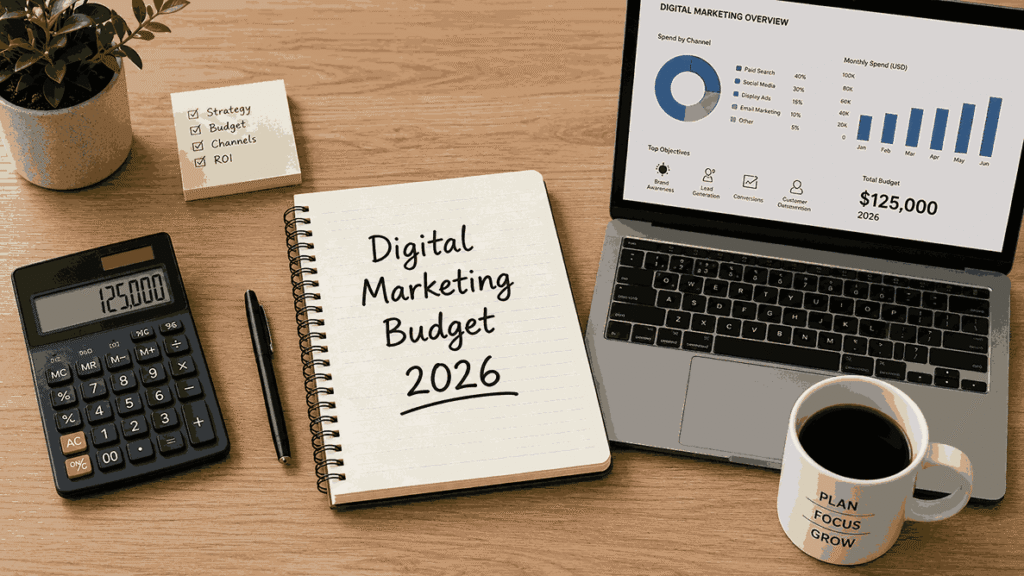
A clean and modern digital marketing budget planning workspace featuring analytics dashboards, budgeting tools, and strategic planning essentials for 2026. How to Budget for Digital Marketing
Step 3: Know Where Your Digital Marketing Budget Can Go
Once you have a budget range in mind, the next part of understanding how to budget for digital marketing is knowing which channels and services to allocate that budget across. Startups often explore How to Budget for Digital Marketing before launching campaigns.
Here’s a breakdown of the main digital marketing investment categories:
Search Engine Optimisation (SEO)
SEO is a long-term investment that builds organic (free) traffic over time. It’s one of the highest ROI channels available — but it requires patience.
Typical investment: ₹10,000–₹50,000/month depending on competition and scope
Best for: Businesses looking for sustainable, compounding growth over 6–12 months
What it includes: Keyword research, on-page optimisation, content creation, link building, technical SEO, local SEO
Pay-Per-Click Advertising (Google Ads / Meta Ads)
PPC delivers immediate visibility and leads. You pay only when someone clicks your ad — making it highly measurable and controllable.
Typical investment: ₹10,000–₹1,00,000+/month (ad spend) + agency management fee
Best for: Businesses that need leads quickly while organic strategies build momentum
What it includes: Search ads, display ads, Shopping campaigns, retargeting, social media ads
Social Media Marketing
Organic social media builds brand awareness and community. Paid social amplifies reach to targeted audiences.
Typical investment: ₹8,000–₹30,000/month for management + ad spend
Best for: Brand building, engagement, e-commerce, local businesses, B2C companies
Content Marketing
Blog articles, videos, infographics, and email newsletters that attract and educate your target audience.
Typical investment: ₹10,000–₹40,000/month depending on volume and format
Best for: SEO support, thought leadership, lead nurturing, long-term brand building
Website Design and Development
Your website is the foundation of all digital marketing. A poor website undermines every other investment.
Typical investment: ₹30,000–₹2,00,000+ (one-time or periodic redesign)
Best for: Any business — a professional, fast, mobile-friendly website is non-negotiable
Email Marketing
One of the highest-ROI channels available. Email marketing nurtures leads and retains existing customers.
Typical investment: ₹5,000–₹20,000/month for strategy, design, and automation
Best for: Businesses with an existing customer base or growing lead list
Step 4: How to Allocate Your Digital Marketing Budget by Priority
Now that you understand the channels, let’s talk about allocation — one of the most practical aspects of how to budget for digital marketing.
The right allocation depends on your goals and business stage:
For New Businesses (Less Than 1 Year Old)
When you’re starting from zero, visibility is everything. A smart allocation might look like:
40% — Paid advertising (Google/Meta Ads) for immediate leads
30% — SEO and content marketing to build long-term organic presence
20% — Social media marketing and content creation
10% — Website development and optimisation
For Growing Businesses (1–3 Years Old)
You have some presence. Now it’s about scaling what works:
35% — SEO and content marketing (compounding value)
35% — Paid advertising for lead generation
20% — Social media and community building
10% — Email marketing and lead nurturing
For Established Businesses (3+ Years Old)
You’re maintaining dominance and expanding reach:
30% — SEO and advanced content marketing
25% — Paid advertising (retargeting, acquisition)
20% — Email marketing and CRM-driven campaigns
15% — Social media and brand marketing
10% — Experimentation and new channels (video, influencers, etc.)
These are guidelines, not gospel. A core principle of how to budget for digital marketing is flexibility — your allocation should shift based on what the data tells you is working.
Step 5: The Hidden Costs of Digital Marketing You Need to Account For
One of the most important — and most overlooked — parts of how to budget for digital marketing is accounting for costs that don’t always show up in an agency’s headline pricing.
Here’s what to factor in:
Tools and Software
Analytics platforms (Google Analytics is free; premium tools like SEMrush, Ahrefs, or HubSpot cost extra)
Photography and videography for social media and ads
Graphic design for campaigns, landing pages, and creatives
Copywriting for ads, websites, and email sequences
Ad Spend vs. Agency Fees This is where many businesses get confused. When an agency charges a management fee, that’s separate from your actual ad spend. Make sure your budget accounts for both.
For example: If your total digital marketing budget is ₹30,000/month and you pay an agency ₹15,000 to manage your Google Ads, you only have ₹15,000 left for actual ad spend. Understanding this distinction is critical to how to budget for digital marketing accurately.
Testing and Experimentation Every smart digital marketer allocates 10–15% of their budget to testing new approaches, channels, or creatives. What works today may not work tomorrow — and what you haven’t tried yet might outperform everything else.
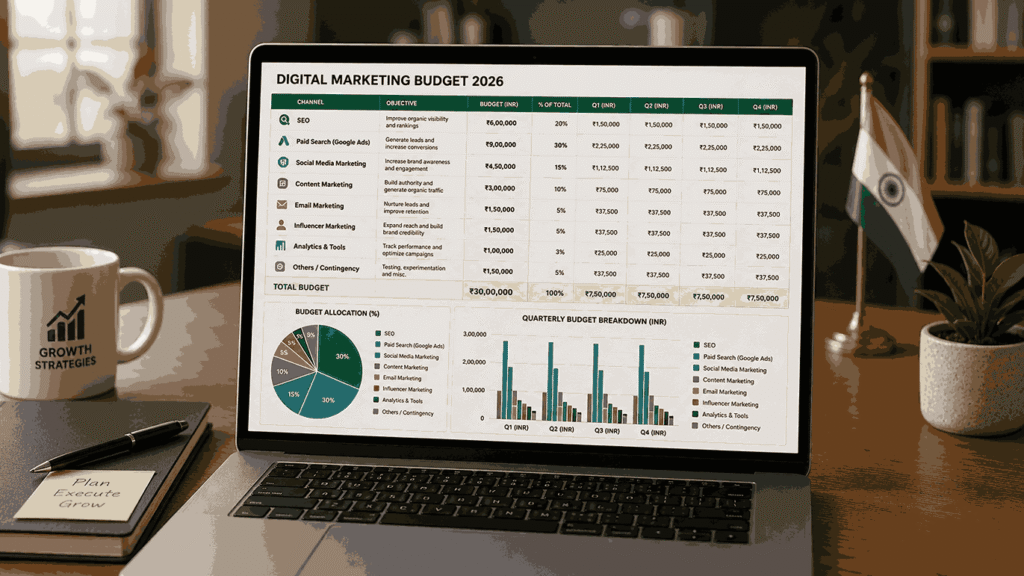
A professional digital marketing budget dashboard showcasing channel-wise budget allocation, analytics charts, and campaign planning in an Indian business workspace. How to Budget for Digital Marketing
Real Story: How One Pune Business Got Its Digital Marketing Budget Right
Let’s make this tangible with a scenario that reflects a very common Pune business reality.
Rajan owns a mid-sized interior design firm in Pune. His business had been growing steadily on referrals for five years — but referrals dried up post-pandemic, and he had no digital presence to fall back on. A clear strategy for How to Budget for Digital Marketing can improve marketing performance.
He reached out to 18 Media Advertising with one question: “I have ₹25,000 a month for digital marketing. Is that enough to make a difference — and if so, where should it go?”
Here’s the plan we built with him, demonstrating exactly how to budget for digital marketing at a realistic SME level:
Channel
Monthly Allocation
Purpose
Local SEO + Content
₹8,000
Build organic visibility for interior design searches in Pune
Google Ads
₹10,000 (ad spend)
Capture high-intent searches like “interior designer Pune” immediately
Monthly performance review and budget optimisation
Results after 4 months:
Google Ads generated 28 qualified enquiries — 6 converted to clients
Instagram grew from 800 to 4,200 followers, with 3 direct enquiries converting to projects
Local SEO pushed his Google Maps listing into the top 3 for “interior designer Pune Koregaon Park”
Total revenue attributed to digital marketing in month 4: ₹4.2 lakhs
From a ₹25,000/month investment. This is what happens when you understand how to budget for digital marketing — and execute with precision.
Step 6: How to Measure Whether Your Digital Marketing Budget Is Working
Investing a budget is one thing. Knowing whether it’s actually working is another — and it’s the part most businesses skip. A clear strategy for How to Budget for Digital Marketing can improve marketing performance.
Understanding how to budget for digital marketing includes understanding which metrics tell you if your money is well spent.
The Metrics That Actually Matter
Cost Per Lead (CPL) How much does it cost you to generate one potential customer enquiry? This is your most immediate efficiency metric.
Cost Per Acquisition (CPA) How much does it cost to convert a lead into an actual paying customer? This connects your marketing spend directly to revenue.
Return on Ad Spend (ROAS) For paid advertising: for every ₹1 you spend on ads, how much revenue do you generate? A ROAS of 3x means ₹1 spent returns ₹3 in revenue.
Organic Traffic Growth Are more people finding your website through Google without you paying for it? This measures the compound value of your SEO investment.
Conversion Rate What percentage of your website visitors take the action you want them to — filling out a form, calling, or making a purchase?
Customer Lifetime Value (CLV) How much is each customer worth to your business over the full course of their relationship with you? This helps you understand how much you can afford to spend to acquire each one.
When to Adjust Your Budget
A key part of how to budget for digital marketing is knowing when to reallocate. Review your budget allocation every quarter and ask:
Which channel is delivering the lowest cost per lead?
Which channel’s performance is declining despite consistent investment?
Are there new opportunities (a new platform, a content format, a targeting option) worth testing?
Has your business goal shifted, requiring a different channel mix?
Data should drive every budget decision — not habit, not assumptions, and not what worked two years ago.
Step 7: Common Budgeting Mistakes to Avoid
Even with the best intentions, businesses make predictable mistakes when figuring out how to budget for digital marketing. Understanding How to Budget for Digital Marketing can help avoid unnecessary spending. Here are the most common ones — and how to avoid them:
Mistake 1: Spreading Too Thin Across Too Many Channels Trying to be everywhere at once with a limited budget means being ineffective everywhere. Focus on two or three channels and do them well before expanding.
Mistake 2: Stopping Investment Before Results Materialise SEO takes time. Content marketing compounds over months. Businesses that pull the plug after 60 days because they haven’t seen results are essentially throwing away all the groundwork they paid for. Understanding how to budget for digital marketing means committing to realistic timelines.
Mistake 3: Separating Brand and Performance Budgets Entirely Brand building (awareness) and performance marketing (lead generation) work best together. The brand you build through social media and content directly improves the conversion rates of your paid campaigns.
Mistake 4: Not Having a Testing Budget The best-performing ad you’ll ever run is one you haven’t created yet. Always reserve 10–15% for testing new creatives, audiences, and messages.
Mistake 5: Forgetting to Account for Seasonality If your business has seasonal peaks — festivals, academic calendars, wedding season — your digital marketing budget should reflect that. Invest more heavily in
A professional Indian entrepreneur reviewing digital marketing budget allocations and campaign strategies on a whiteboard in a modern office environment. How to Budget for Digital Marketing
How 18 Media Advertising Helps You Build and Manage the Right Digital Marketing Budget
At 18 Media Advertising, we have one very simple belief: your marketing budget should work as hard as you do.
We’ve helped businesses across Pune — startups with tight budgets and established companies with significant marketing spend, figure out exactly how to budget for digital marketing in a way that is realistic, strategic, and results-focused. A structured approach to How to Budget for Digital Marketing supports measurable results.
Here’s what working with us looks like:
Free initial consultation — We understand your business, goals, and current digital position before recommending a single rupee of spend
Custom budget recommendation — Based on your goals, industry, and competitive landscape, we recommend a channel mix and budget allocation that makes sense
Transparent pricing — You always know what you’re paying for — agency fees, ad spend, tools, and deliverables are clearly separated
Monthly budget reviews — We track performance and adjust allocation based on what the data shows is working best
No lock-in contracts — We earn your continued investment by delivering results, not by trapping you in long-term agreements
Whether you’re just starting to think about how to budget for digital marketing or you’re looking to optimise an existing marketing investment, 18 Media Advertising is the partner built to help you get there.
A Simple Digital Marketing Budget Template to Get You Started
Here’s a basic template you can adapt for your own business:
Category
% of Total Budget
Monthly Amount (Example: ₹30,000 total)
SEO and Content Marketing
30%
₹9,000
Paid Advertising (Ad Spend)
35%
₹10,500
Social Media Management
20%
₹6,000
Email Marketing
10%
₹3,000
Testing and Experimentation
5%
₹1,500
Adjust percentages based on your specific goals, business stage, and channel performance. The most important thing is that you have a plan — and that plan is reviewed regularly.
Understanding how to budget for digital marketing isn’t a one-time exercise. It’s an ongoing discipline that gets smarter and more effective with every month of data you accumulate. Businesses aiming for online growth should understand How to Budget for Digital Marketing carefully.
Conclusion: Budgeting for Digital Marketing Doesn’t Have to Be Overwhelming
Let’s bring this full circle.
Knowing how to budget for digital marketing starts with your goals — not a number. It’s built on an understanding of which channels are right for your business, realistic benchmarks for your industry, and a commitment to measuring, learning, and optimising continuously.
It’s not about spending the most. It’s about spending the smartest.
And you don’t have to figure it all out alone. That’s exactly what 18 Media Advertising is here for.
We’ve helped hundreds of businesses across Pune and beyond navigate exactly this challenge — turning unclear budgets into clear strategies, and clear strategies into measurable growth. From the first rupee to the full-funnel campaign, we help you make every marketing investment count.
If you’ve been going back and forth on how to budget for digital marketing for your business, the best next step is a simple, no-pressure conversation with our team. We’ll listen, we’ll analyse, and we’ll give you a clear, honest picture of what’s possible — and what it takes to get there.
🚀 Stop Guessing. Start Growing. Let’s Build Your Budget Together.
Connect with 18 Media Advertising today and get expert guidance on building a digital marketing budget that delivers real results.
Your next chapter of growth is one smart conversation away.
👉 Visit our website, explore our services, and let’s create a digital marketing budget that works as hard as your business does.
Frequently Asked Questions (FAQs)
1. How do I know how to budget for digital marketing if I’ve never done it before?
The best starting point is to define your business goal for the next 12 months, then work backwards. How many customers do you need? How many leads does that require? Multiply by your target cost per lead, and you have a rough budget. If this feels overwhelming, speaking to a professional agency like 18 Media Advertising is the most efficient way to get clarity fast. We guide new businesses through exactly how to budget for digital marketing at every stage of the process.
2. What percentage of revenue should I spend on digital marketing?
A commonly used benchmark for how to budget for digital marketing is 5–12% of annual revenue for established businesses, and 12–20% for newer businesses that need to build visibility quickly. However, the right percentage depends on your industry competitiveness, growth ambitions, and the specific channels you invest in. An agency consultation can help you determine the right number for your specific situation.
3. Should I include agency fees in my digital marketing budget?
Yes — absolutely. When planning how to budget for digital marketing, you need to account for both the cost of ad spend (money paid to platforms like Google and Meta) and agency management fees (paid to the team creating and optimising your campaigns). These are two separate costs and both should be included in your total marketing budget to get an accurate picture of your overall investment.
4. How often should I review and adjust my digital marketing budget?
A good rule of thumb is to conduct a detailed budget review every quarter and a lighter monthly review of performance metrics. Understanding how to budget for digital marketing is an ongoing process — your allocation should shift based on what the data tells you is working. Channels that are performing well deserve more investment; those underperforming should be paused, tested with new approaches, or replaced with higher-ROI alternatives.
5. Can a small business in Pune see real results with a limited digital marketing budget?
Absolutely. Knowing how to budget for digital marketing smartly matters far more than having a large budget. Many of 18 Media Advertising’s clients in Pune started with modest monthly investments and achieved significant growth by focusing on the right channels with precise targeting and consistent optimisation. Local SEO, a well-managed Google My Business profile, and a disciplined paid advertising approach can generate meaningful results even on a budget of ₹15,000–₹25,000 per month when executed strategically.