Introduction: Is Your Indian Business Still Waiting to Go Digital?
Here’s a number that should stop you in your tracks: India is home to over 900 million internet users — and that figure is still climbing. Many professionals are exploring the scope of digital marketing in India for best revenue generation opportunities. Understanding the scope of digital marketing in India can help you plan your next move.
Every single day, millions of Indian consumers are searching Google for products, scrolling Instagram for recommendations, watching YouTube reviews before making purchase decisions, and clicking on WhatsApp links shared by friends and family.
For businesses operating in India, this isn’t just a trend. It’s a tectonic shift in how buying decisions are made — and it’s happening right now, with or without you.
The scope of digital marketing in India for businesses has never been broader, deeper, or more accessible than it is in 2026. Whether you run a neighborhood kirana store in Nagpur, a growing D2C brand in Bengaluru, or a B2B services firm in Mumbai — the digital opportunity in front of Indian businesses today is genuinely historic.
But opportunity without understanding is just noise. So in this guide, we’re going to break down exactly what this scope looks like, why it matters for your specific business, and how to position yourself to capture it.
Let’s get into it.
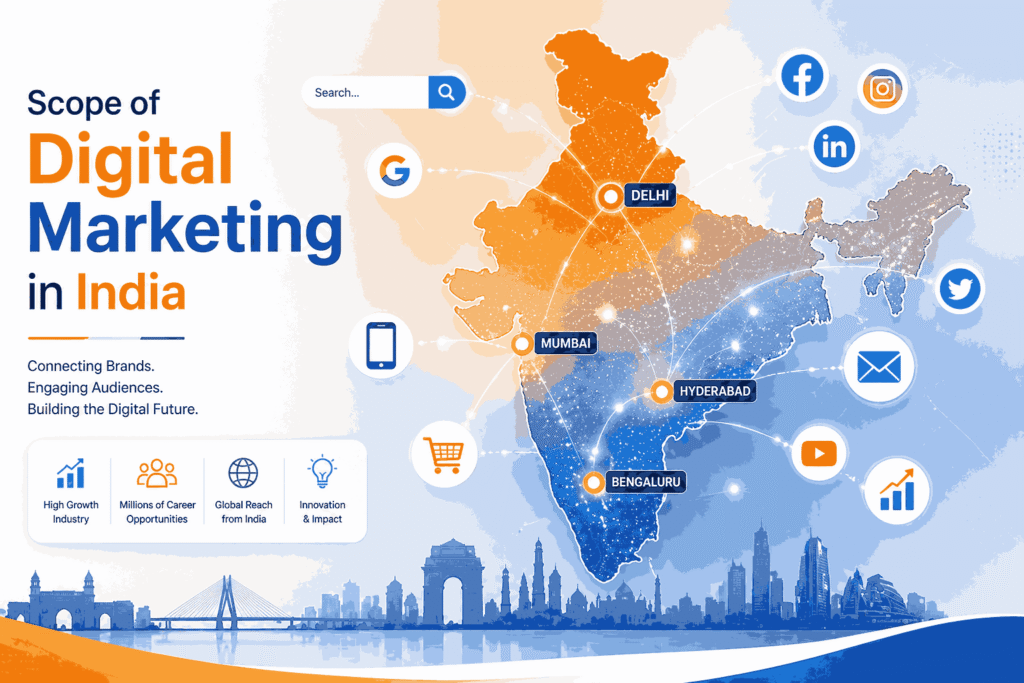
A vibrant illustration showing how digital marketing spreads across India’s major cities through connected online channels and technologies.
Why the Scope of Digital Marketing in India Is Unlike Any Other Market
India isn’t just another country going digital. It’s one of the most unique and exciting digital markets in the entire world — and here’s why that matters for your business specifically. The scope of digital marketing in India continues to expand with increasing internet usage.
The Scale Is Staggering
Let’s put some numbers on the table:
India has over 900 million internet users as of 2024 — the second-largest internet user base in the world, after China.
India adds approximately 25–30 million new internet users every year.
The Indian digital advertising market is projected to cross ₹55,000 crore (approximately $6.5 billion) by 2026, growing at roughly 25–30% year-on-year.
India is the world’s largest market for mobile data consumption — Indian users consume more mobile data per capita than any other country on earth.
Over 700 million Indians access the internet primarily through smartphones, not desktops.
These aren’t abstract statistics. For your business, they translate into a concrete reality: your customers — existing and potential — are online, on mobile, and actively looking for products and services like yours.
India’s Unique Digital Characteristics
The scope of digital marketing in India is driven by businesses shifting online. What makes the Indian market particularly interesting for digital marketing is its diversity combined with its rapidly growing digital infrastructure:
Regional language internet users are exploding. Google reports that Hindi, Tamil, Telugu, Bengali, and other regional language users are growing 2–3x faster than English internet users in India. Businesses that communicate in regional languages have a massive, largely untapped audience.
WhatsApp is the dominant communication channel with over 500 million active users in India — making WhatsApp marketing uniquely powerful here compared to almost any other market globally.
UPI and digital payments have removed one of the biggest barriers to online purchasing. With over 13 billion UPI transactions happening monthly in India, the path from digital marketing to digital purchase has never been smoother.
Tier-2 and Tier-3 cities are now major digital markets. Cities like Jaipur, Surat, Coimbatore, Indore, and Lucknow have seen dramatic surges in internet adoption — creating vast new audiences for businesses willing to target them.
The Scope of Digital Marketing in India Across Different Business Categories
One of the most important things to understand is that the scope of digital marketing in India isn’t uniform — it varies significantly depending on what type of business you run. The scope of digital marketing in India is driven by businesses shifting online. Let’s break it down.
Local and Small Businesses
For decades, local businesses in India relied on word of mouth, local newspaper ads, flex banners, and referrals. The scope of digital marketing in India is driven by businesses shifting online. That world hasn’t disappeared — but it’s been dramatically supplemented by digital channels that small businesses can access at a fraction of the traditional cost. The scope of digital marketing in India is driven by businesses shifting online.
Consider this scenario:
Suresh runs a modest coaching center for competitive exams in Indore. Three years ago, his student intake was entirely dependent on local referrals and hand-distributed pamphlets. After working with a digital marketing consultant, he launched a YouTube channel with free exam tips, optimized his Google Business Profile, and ran low-budget Facebook Ads targeted at students aged 17–22 in Indore.
Within 18 months, his monthly inquiries had tripled. Students from neighboring cities like Bhopal and Ujjain were reaching out. He hadn’t increased his infrastructure cost at all — he’d simply become discoverable to an audience that was already looking for what he offered.
This story plays out across India every day — in salons, gyms, clinics, tutoring centers, and retail shops. The digital playing field has genuinely been leveled.
Key digital opportunities for local businesses in India:
Google Business Profile optimization for local search visibility
WhatsApp Business for customer communication and promotions
Facebook and Instagram for community building and local advertising
Local SEO targeting city-specific keywords
Google Maps advertising for location-based discovery
D2C (Direct-to-Consumer) Brands
India’s D2C ecosystem has exploded over the last five years. Brands like boAt, Mamaearth, Sugar Cosmetics, and Boat have shown conclusively that Indian consumers are ready and willing to discover, evaluate, and buy directly from brands online — without needing a traditional retail presence.
The digital marketing scope for D2C brands in India includes:
Instagram and YouTube for product discovery and influencer partnerships
Google Shopping Ads for high-intent purchase traffic
Email and WhatsApp marketing for repeat purchase nurturing
Content marketing and SEO for organic, long-term traffic
Performance marketing (Meta Ads + Google Ads) for scalable customer acquisition
The Indian D2C market is projected to reach $100 billion by 2025, according to industry estimates — and digital marketing is the primary engine driving that growth.
B2B Businesses and Service Companies
Many Indian B2B businesses have been slower to embrace digital marketing — operating under the assumption that corporate clients aren’t “online buyers.” This is an increasingly outdated belief.
Indian B2B buyers are researching vendors online, comparing options on LinkedIn, reading case studies and testimonials, and making shortlists based on digital presence — before a single sales call ever happens.
The digital marketing scope for B2B businesses in India:
LinkedIn marketing — The premier platform for reaching Indian business decision-makers
SEO and content marketing — Long-form content that positions your brand as the expert in your field
Webinars and virtual events — Building trust and demonstrating expertise at scale
Email marketing — Nurturing long B2B sales cycles with relevant, valuable content
Case studies and testimonials — Social proof that closes deals before your sales team does
E-Commerce Businesses
India’s e-commerce market is one of the fastest-growing in the world. While giants like Amazon and Flipkart dominate, there’s enormous space for niche and category-specific online stores — particularly those that combine great digital marketing with excellent product curation.
Indian e-commerce is projected to reach $350 billion by 2030, creating massive headroom for both new entrants and existing businesses expanding online.
Digital marketing is the fuel that powers e-commerce at every stage:
SEO drives organic product discovery
Google and Meta Ads drive targeted paid traffic
Email automation converts browsers into buyers and buyers into repeat customers
Influencer marketing builds product credibility through trusted voices
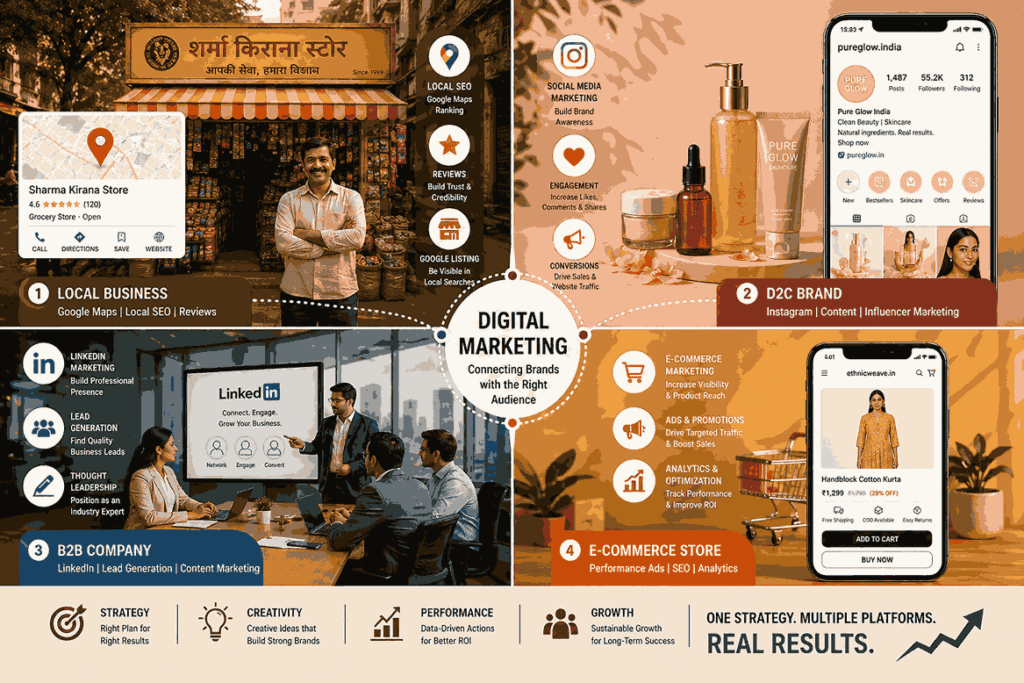
One strategy, multiple platforms—see how digital marketing connects local, D2C, B2B, and e-commerce businesses for real growth.
13 Specific Growth Opportunities That Define the Scope of Digital Marketing in India for Businesses
Now let’s get specific. Here are 13 concrete opportunities that define just how wide the scope of digital marketing in India actually is for businesses right now.
1. Regional Language Digital Marketing
Over 600 million Indian internet users prefer content in languages other than English. Businesses that create content in Hindi, Tamil, Telugu, Kannada, Marathi, Bengali, or other regional languages can access audiences that are significantly less competitive than English-language digital marketing.
2. Voice Search Optimization
With the rise of smart speakers and voice assistants in Indian homes, and millions of Indian users relying on voice search in regional languages, businesses that optimize for voice search queries now are building an advantage that most competitors haven’t even started thinking about.
3. YouTube and Video Marketing
India is one of YouTube’s largest markets in the world. Indian users watch billions of hours of video content every month. For businesses, YouTube represents an enormous opportunity to educate, demonstrate, and build trust with audiences at scale — often with far less competition than text-based content.
4. WhatsApp Business Marketing
No other country in the world uses WhatsApp as intensively as India. For businesses, WhatsApp Business offers direct, personal communication with customers — order updates, promotional messages, customer support, product catalogues, and more. The open rates on WhatsApp messages dwarf those of email, making it uniquely powerful in the Indian context.
5. Hyperlocal Digital Advertising
Platforms like Google Ads and Meta Ads allow Indian businesses to run hyperlocal campaigns — targeting users within a 2–5 km radius of a physical location. For local service businesses (clinics, gyms, salons, restaurants, coaching centers), this targeting precision is game-changing.
6. Influencer Marketing With Micro and Nano Influencers
The scope of digital marketing in India is influenced by rapid technological adoption. India has a vast ecosystem of regional micro-influencers — content creators with 10,000–100,000 followers in specific niches and geographies. These influencers often deliver significantly higher engagement rates and more authentic audience relationships than celebrity influencers, at a fraction of the cost.
Indian businesses — particularly in fashion, food, health, education, and beauty — are finding that a well-chosen micro-influencer partnership delivers better ROI than traditional advertising.
7. Mobile-First Marketing
Businesses are investing more due to the scope of digital marketing in India. The scope of digital marketing in India is expanding due to increased smartphone usage. The scope of digital marketing in India is closely linked to the rise of online consumers. With over 700 million smartphone internet users in India, every digital marketing strategy must be designed for mobile first. This means mobile-optimized websites, vertical video content, click-to-call ads, and WhatsApp-integrated customer journeys.
Businesses that design for desktop and “adapt” to mobile are already behind. Mobile-first is the only approach that makes sense in the Indian market.
8. E-Commerce Marketplace Marketing
The scope of digital marketing in India supports both small and large businesses. Beyond independent online stores, platforms like Amazon India, Flipkart, Meesho, and Myntra offer businesses the ability to reach tens of millions of Indian shoppers who already trust these platforms. Optimizing product listings, running marketplace ads, and managing reviews on these platforms is a growing and profitable subset of digital marketing in India.
9. Content Marketing in Underserved Niches
The scope of digital marketing in India continues to grow with digital transformation. Many Indian industries are still relatively underserved from a content marketing perspective. The scope of digital marketing in India is shaping the future of marketing strategies. Agriculture, regional manufacturing, tier-2 city real estate, vernacular education, and traditional crafts are just a few examples of niches where a well-executed content marketing strategy can dominate search results relatively quickly. Many learners are curious about the scope of digital marketing in India.
10. Performance Marketing and Programmatic Advertising
As India’s digital advertising ecosystem matures, programmatic advertising — automated, data-driven ad placement across multiple platforms simultaneously — is becoming increasingly accessible to mid-sized Indian businesses. This allows for more efficient ad spend and better audience targeting at scale. The scope of digital marketing in India is becoming a key factor in business success. As more people go online, the scope of digital marketing in India keeps increasing.
11. Online Reputation Management
The scope of digital marketing in India is closely linked to the rise of online consumers, and the scope of digital marketing in India is evolving with changing market trends. In a market where 81% of consumers research a product online before purchasing, managing your business’s online reputation — Google reviews, Justdial ratings, social media mentions — is a significant and growing digital marketing function. Businesses with strong online reputations have a measurable advantage in conversion rates. The scope of digital marketing in India makes it a promising field for the future.
12. Email and Marketing Automation
Despite being one of the most effective digital marketing channels globally, email marketing remains underutilized by Indian businesses — which actually represents a major opportunity. Businesses that build and nurture email lists now are building assets that will pay dividends for years. As more people go online, the scope of digital marketing in India keeps increasing.
Combined with marketing automation tools, email sequences can guide potential customers through the entire decision journey without requiring manual intervention — scaling the sales process without scaling headcount.
13. Data Analytics and Conversion Rate Optimization (CRO)
The most sophisticated Indian businesses are now going beyond just driving traffic — they’re obsessing over what happens to that traffic. Conversion Rate Optimization (CRO) involves analyzing user behavior on websites and making targeted improvements to increase the percentage of visitors who take a desired action. The scope of digital marketing in India is becoming a key factor in business success.
In a competitive digital environment, even a 1–2% improvement in conversion rate can translate into significant revenue gains — without spending a single additional rupee on advertising.
The Challenges Indian Businesses Face in Digital Marketing — And How to Overcome Them
A clear understanding of the scope of digital marketing in India helps in better decision-making. Understanding the scope of digital marketing in India also means being honest about the challenges that hold many Indian businesses back.
Challenge 1: Lack of digital marketing knowledge Many Indian business owners, particularly in traditional sectors, don’t know where to start with digital marketing. The solution isn’t to learn everything overnight — it’s to start with one channel, see results, and build from there. Or partner with a trusted digital marketing agency that specializes in your industry.
Challenge 2: Inconsistent execution Starting a blog, posting on Instagram for two weeks, and then going quiet is worse than not starting at all. Consistency is the single most important factor in digital marketing success. Even a modest, consistent effort beats sporadic bursts of activity.
Challenge 3: Measuring ROI Many businesses struggle to connect their digital marketing efforts to actual business results. Setting up Google Analytics, tracking conversions, and defining clear KPIs from day one solves this problem. What gets measured, gets improved.
Challenge 4: Over-reliance on paid ads Some businesses spend heavily on Google or Meta ads without building any organic presence. When ad budgets get cut, traffic evaporates. The most resilient digital marketing strategies balance paid and organic channels.
Challenge 5: Ignoring mobile optimization With the majority of Indian internet users accessing content on mobile, a website or email that isn’t mobile-optimized is actively losing business. This is a fixable problem — but only if you acknowledge it first.
(External link suggestion: Reference NASSCOM’s annual India Tech Report for data on digital adoption trends among Indian businesses)
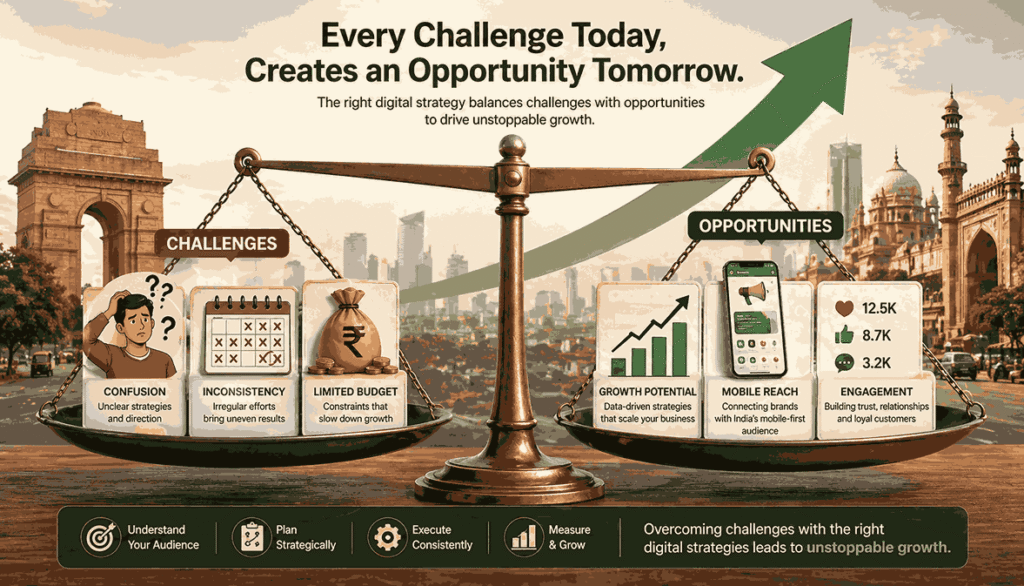
Balancing challenges and opportunities in digital marketing helps businesses achieve sustainable growth in today’s competitive Indian market.
How Indian Businesses Should Prioritize Their Digital Marketing in 2026
Given the breadth of opportunity, the biggest risk for Indian businesses is trying to do everything at once and executing nothing well. Here’s a practical prioritization framework:
Stage 1 — Foundation (Month 1–2)
Optimize your Google Business Profile completely
Ensure your website is mobile-friendly and fast
Set up Google Analytics and Google Search Console
Claim and complete your social media profiles
Stage 2 — Organic Growth (Month 2–4)
Begin publishing SEO-optimized content targeting your most valuable keywords
Post consistently on 1–2 social media platforms where your audience is most active
Start building your WhatsApp Business contact list
Collect and manage Google reviews actively
Stage 3 — Paid Amplification (Month 4–6)
Launch targeted Google Ads or Meta Ads campaigns with a defined budget and clear goal
Experiment with hyperlocal advertising if you have a physical business location
Explore micro-influencer partnerships relevant to your product or service category
Stage 4 — Scale and Optimize (Month 6+)
Build and nurture an email list with automated welcome and nurture sequences
Analyze data to double down on what’s working and cut what isn’t
Explore regional language content to access untapped audience segments
Consider programmatic advertising as your budget and expertise grow
This staged approach prevents overwhelm, builds skills progressively, and ensures each investment is informed by real data from the previous stage.
Conclusion: The Scope of Digital Marketing in India Is a Once-in-a-Generation Business Opportunity
Let’s step back and look at the full picture.
The scope of digital marketing in India for businesses in 2026 is not incremental — it’s transformational. We are living through a moment where over 900 million Indians are online, where mobile internet is cheaper than almost anywhere else in the world, where UPI has removed barriers to digital commerce, and where consumers across every tier of city are making purchasing decisions based on what they find online.
Here’s what we covered in this guide:
India’s scale and unique digital characteristics that make it one of the most exciting business markets in the world
How the digital marketing scope plays out differently for local businesses, D2C brands, B2B companies, and e-commerce players
13 specific growth opportunities — from regional language marketing and WhatsApp to influencer partnerships and CRO
The real challenges Indian businesses face — and honest, practical ways to overcome them
A staged prioritization framework to implement digital marketing without overwhelm
The Indian businesses that will lead their industries in 2026 and beyond aren’t necessarily the biggest or the oldest — they’re the ones that understand digital marketing, execute it consistently, and adapt based on data.
The scope is massive. The tools are accessible. The audience is waiting.
The only question is — are you ready to show up for them digitally?
🚀 Your Business’s Digital Journey Starts With One Step
You’ve just spent time understanding one of the biggest business opportunities in India right now. Don’t let that insight sit idle.
👉 Take one action this week. Claim your Google Business Profile. Post your first Instagram reel. Send your first WhatsApp broadcast. Publish your first blog post. Whatever it is — start this week, with 18 Media Advertising”
India’s digital economy is growing every single day. Your business deserves to grow with it. Connect with 18 Media Advertising for a FREE Consultation.
Frequently Asked Questions About the Scope of Digital Marketing in India
Q1: How big is the scope of digital marketing in India for small businesses specifically? The scope is enormous — and arguably bigger for small businesses than anyone else. Small businesses in India can now compete with large brands on Google through SEO and content marketing, reach hyperlocal audiences through targeted social media ads, and build direct customer relationships through WhatsApp — all without the massive budgets that traditional advertising used to require. Today, the scope of digital marketing in India is broader than ever before. The democratization of digital tools has genuinely leveled the playing field for small Indian businesses.
Q2: Which digital marketing channel offers the best ROI for Indian businesses in 2026? It depends on your business type and stage, but SEO and content marketing consistently deliver the best long-term ROI because the traffic compounds over time at no additional cost. For immediate results, Google Ads targeting high-intent search queries and WhatsApp marketing for existing customer bases tend to deliver strong returns for Indian businesses. Email marketing, once the list is built, also delivers exceptional ROI consistently.
Q3: Is regional language digital marketing really worth it for Indian businesses? Absolutely — and it’s one of the most underutilized opportunities in the country right now. Hindi, Tamil, Telugu, Bengali, Marathi, and Kannada internet users represent hundreds of millions of potential customers who are significantly less targeted by most businesses. Creating content, ads, and communication in regional languages allows businesses to build deeper trust and often face far less competition than in English-language digital marketing.
Q4: How does the scope of digital marketing in India compare to traditional marketing for businesses? Digital marketing offers several decisive advantages over traditional marketing in the Indian business context: precise audience targeting (instead of broad broadcast), measurable results (track every rupee spent), significantly lower costs to get started, the ability to reach pan-India and global audiences from a local base, and two-way engagement with customers. Traditional marketing still has its place for awareness, but for most Indian businesses, digital marketing delivers better ROI and more actionable data.
Q5: What is the minimum budget an Indian business needs to start digital marketing effectively? There’s genuinely no fixed minimum — because many of the most powerful digital marketing strategies in India cost primarily time, not money. Setting up a Google Business Profile, publishing SEO-optimized content, posting consistently on social media, and building a WhatsApp contact list can all be done at zero direct cost. For paid advertising, even ₹5,000–₹10,000 per month on well-targeted Google or Facebook Ads can deliver meaningful results for a local business. The key is starting with a clear goal and the right channel — not a large budget.