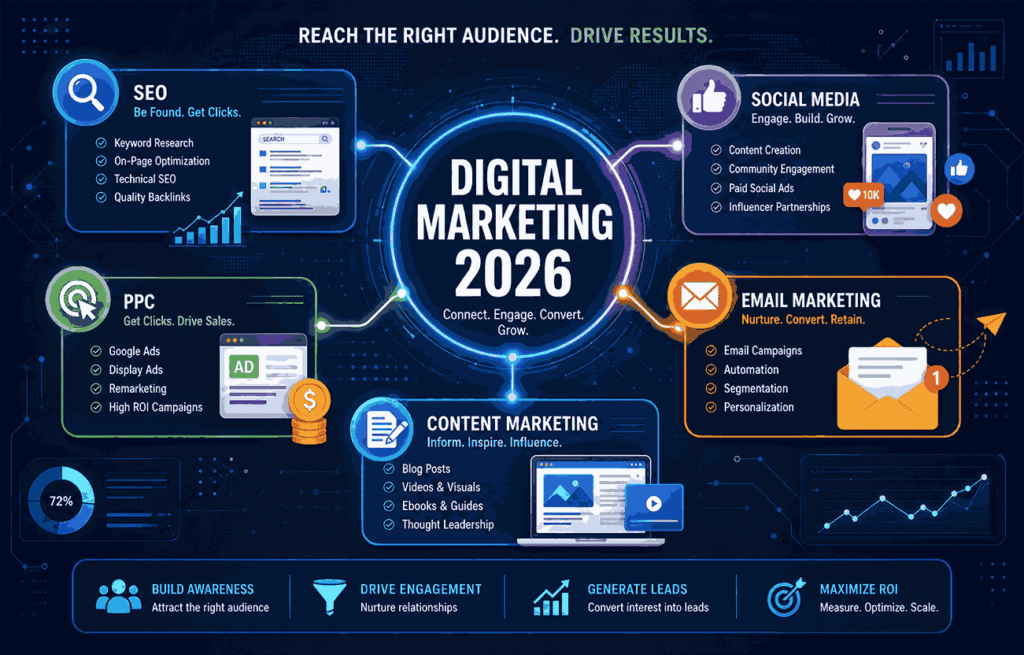
Introduction: The Question Every Business Owner Is Asking Right Now
What is digital marketing? If you’ve typed that into Google at least once, you’re not alone. Millions of entrepreneurs, students, and small business owners search that exact phrase every single month — and for good reason.Before going further, let’s first understand what is digital marketing.
We live in a world where your customer scrolls Instagram before breakfast, reads a blog post during lunch, and watches a YouTube review before making a purchase at night. Many people still wonder what is digital marketing and how it actually works. If your business isn’t showing up during those moments, someone else’s is.
What is digital marketing? Digital marketing is no longer a “nice to have.” In 2026, it’s the difference between a business that grows and one that slowly fades into irrelevance. To understand growth today, it’s important to know what is digital marketing.
When service providers ask, what is digital marketing, they want to generate consistent leads through digital channels, or when aspiring entrepreneurs explore what is digital marketing, they’re taking their first step toward building a strong online presence, or when corporate professionals ask, what is digital marketing, they’re often planning a transition into the online business space.
Or when local shop owners ask, what is digital marketing, they’re curious about reaching customers beyond their physical location. When new business owners ask, what is digital marketing, they’re trying to understand how online promotion actually works, or when startup founders ask, what is digital marketing, they’re often looking for smarter ways to grow their brand online.
In this guide, we’ll break down exactly what digital marketing is, how it works, which channels matter most, and why choosing digital marketing as your core growth strategy is one of the smartest business decisions you can make this year. It’s natural to be curious about what is digital marketing in today’s digital world.
Let’s dive in.
What Is Digital Marketing? A Clear, Simple Definition
At its core, digital marketing is the promotion of products, services, or brands through digital channels and technologies. These include search engines, social media platforms, email, websites, mobile apps, and more. At this stage, you may be thinking what is digital marketing and why it matters.
Unlike traditional marketing (think: TV ads, billboards, print flyers), digital marketing allows you to reach your target audience exactly where they spend most of their time — online.
Here’s a quick comparison:
| Traditional Marketing | Digital Marketing |
|---|---|
| TV, radio, print | Google, Instagram, YouTube |
| Broad audience targeting | Laser-precise targeting |
| Hard to measure ROI | Real-time data and analytics |
| High upfront costs | Scalable budgets for any size |
| One-way communication | Two-way engagement with customers |
The simplest way to think about it: digital marketing = meeting your customers where they already are.
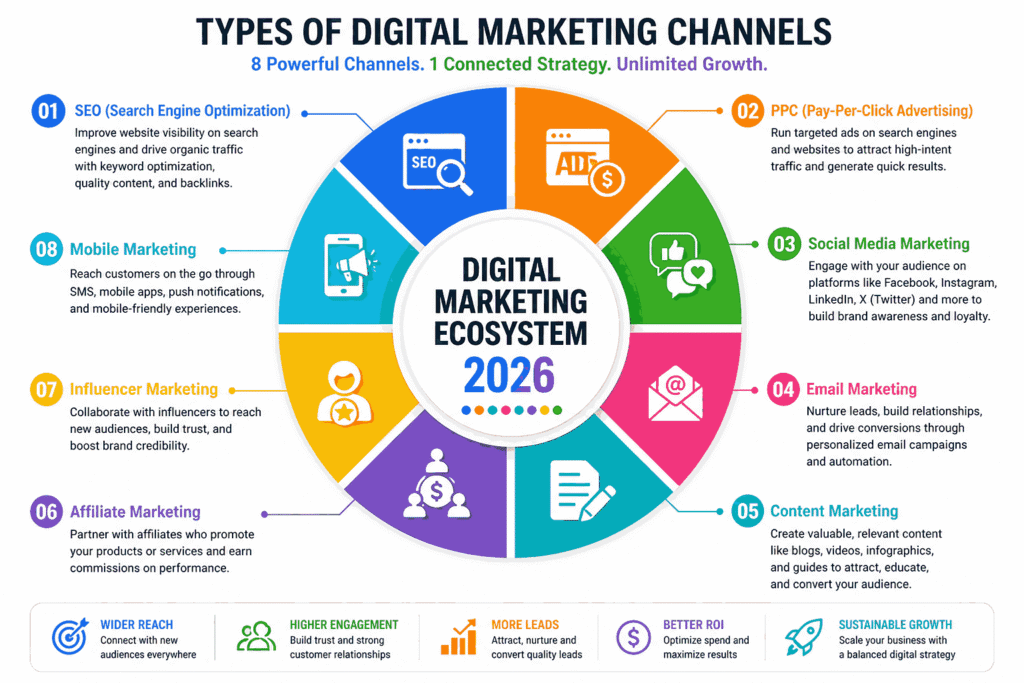
The 8 Core Types of Digital Marketing You Need to Know
Understanding what digital marketing is means understanding its major channels. Let’s walk through each one. A lot of confusion disappears once you understand what is digital marketing. Without understanding what is digital marketing, it’s hard to move ahead.
1. Search Engine Optimisation (SEO)
When startup founders or people in general ask you, “What is digital marketing?” you can introduce them to SEO, which one of the most organic ways to establish the long-term visibility of your brand. SEO is the practice of optimising your website so it ranks higher on search engines like Google. When someone types “best running shoes under ₹3000,” a well-optimised website appears on page one — and that means free, targeted traffic.
Why it matters: According to BrightEdge, organic search drives over 53% of all website traffic. That’s more than paid ads, social media, and email combined.
2. Pay-Per-Click Advertising (PPC)
When startup founders ask, what is digital marketing, they’re often looking for smarter ways to grow their brand online and PPC, which allows you to place paid ads on platforms like Google Ads, Meta Ads, or LinkedIn. Still, when people ask you “What is digital marketing?” you can talk about these topics. You pay only when someone clicks your ad — hence the name.
Example: A local bakery in Mumbai runs a Google PPC campaign targeting “custom birthday cakes in Mumbai.” Within 48 hours, they receive 30 inquiries. That’s the power of intent-based advertising.
3. Social Media Marketing
When small business owners wonder, what is digital marketing, they’re usually trying to understand how to attract more customers digitally. Where social media marketing involves creating and sharing content on platforms like Instagram, Facebook, LinkedIn, YouTube, and X (formerly Twitter) to build brand awareness, engagement, and sales.
In 2026, short-form video (Reels, YouTube Shorts) continues to dominate, with studies showing video content gets 1200% more shares than text and image posts combined.
4. Content Marketing
When entrepreneurs search for what is digital marketing, they want to discover modern strategies to scale their business or when startup founders or people in general ask you, “What is digital marketing?” you can introduce them to Content marketing, which focuses on creating valuable, relevant content — blog posts, videos, podcasts, infographics — that attracts and retains your audience.
Story time: HubSpot, one of the world’s leading marketing software companies, built its entire empire on content marketing. Their blog generates millions of monthly visitors and is responsible for a massive portion of their leads. They didn’t just sell software — they educated an industry.
5. Email Marketing
When local shop owners ask, what is digital marketing, they’re curious about reaching customers beyond their physical location & here email remains one of the highest-ROI digital marketing channels available. For every ₹1 (or $1) spent on email marketing, businesses see an average return of $36, according to Litmus.
Email marketing includes:
- Welcome sequences for new subscribers
- Promotional campaigns and offers
- Abandoned cart recovery emails
- Monthly newsletters
- Re-engagement campaigns
6. Affiliate Marketing
When freelancers explore what is digital marketing, they’re aiming to promote their personal brand effectively, and when startup founders or people in general ask you, “What is digital marketing?” you can introduce them to affiliate marketing is a performance-based model where businesses reward partners (affiliates) for driving traffic or sales. Think of it as hiring a commission-only sales team that works around the clock.
Platforms like Amazon Associates and ShareASale have made affiliate marketing accessible for creators, bloggers, and influencers of all sizes.
7. Influencer Marketing
When e-commerce sellers search for what is digital marketing, they’re looking for ways to boost their online sales. When startup founders or people in general ask you, “What is digital marketing?” you can tell them that influencer marketing connects brands with trusted content creators who promote products to their loyal audiences. In 2026, micro-influencers (10,000–100,000 followers) often outperform mega-celebrities in terms of engagement and conversion because their audiences are more niche and trust them deeply.
8. Mobile Marketing
When new business owners ask, what is digital marketing, they’re trying to understand how online promotion actually works or when startup founders or people in general ask you, “What is digital marketing?” you can tell them that how mobile marketing is booming & with over 7.1 billion smartphone users globally (Statista, 2025), mobile marketing — including SMS campaigns, push notifications, and in-app advertising — is no longer optional. If your website isn’t mobile-optimised, you’re already losing customers.
Why Digital Marketing Is the Best Choice for Businesses in 2026
Now that we’ve answered “what is digital marketing,” let’s talk about why it’s the smartest strategy for your business right now.
Reason 1: Unmatched Targeting Precision
Traditional advertising is a shotgun approach — you broadcast to everyone and hope your ideal customer happens to see it. Digital marketing is a sniper rifle.
With digital tools, you can target people based on:
- Demographics — age, gender, location, income
- Interests — hobbies, favourite brands, content they consume
- Behaviour — past purchases, websites visited, apps used
- Intent — what they’re actively searching for right now
This precision means lower wasted spend and higher conversion rates.
Reason 2: Real-Time Performance Data
One of the most underrated advantages of digital marketing is measurability. You don’t have to guess whether your billboard worked. With tools like Google Analytics 4, Meta Business Suite, and SEMrush, you can see:
- How many people saw your ad
- How many clicked
- How many converted into customers
- Exactly how much each sale cost you
This data-driven approach allows you to double down on what works and cut what doesn’t — in real time.
Reason 3: Cost-Effectiveness for All Business Sizes
You don’t need a ₹50 lakh marketing budget to compete. A well-crafted blog post can outrank a Fortune 500 company’s paid ad. A viral Instagram Reel costs nothing to create but can reach millions.
Digital marketing levels the playing field. A startup in Nashik can compete with a corporation in New York if their SEO, content, and social strategy are stronger.
Reason 4: Global Reach, Local Focus
Digital marketing gives you access to a global audience while still allowing hyper-local targeting. A restaurant in Pune can run Instagram ads only visible to food lovers within a 5-km radius. Meanwhile, a SaaS company in Bengaluru can sell its software to customers in Germany, Brazil, and Canada — simultaneously.
Reason 5: Builds Long-Term Brand Authority
Consistently publishing valuable content, earning backlinks, maintaining an active social presence, and collecting positive reviews builds something traditional advertising never could: trust.
In 2026, consumers are more sceptical than ever. They research before they buy. They read reviews. They follow brands for weeks before making a purchase. Digital marketing meets them at every stage of that journey.
Reason 6: Automation and Scalability
Modern digital marketing tools allow you to automate repetitive tasks — email sequences, social scheduling, ad bidding, lead nurturing — so your marketing works even when you’re asleep.
Tools like:
- Mailchimp / Klaviyo — email automation
- Buffer / Hootsuite — social media scheduling
- Google Smart Bidding — automated PPC optimisation
- HubSpot / Zoho CRM — lead management
…allow even a one-person team to run marketing operations that rival larger companies.
For more insights check this article – Top 8 Digital Marketing Trends for 2024
Reason 7: AI Is Making Digital Marketing Smarter Than Ever
In 2026, artificial intelligence has transformed digital marketing from a manual effort into a predictive, personalised engine. AI tools now help with:
- Writing and optimising ad copy
- Predicting which customers are most likely to buy
- Personalising email content for individual subscribers
- Generating SEO content outlines at scale
- Analysing competitor strategies in seconds
Businesses that combine human creativity with AI-powered efficiency are seeing unprecedented growth.
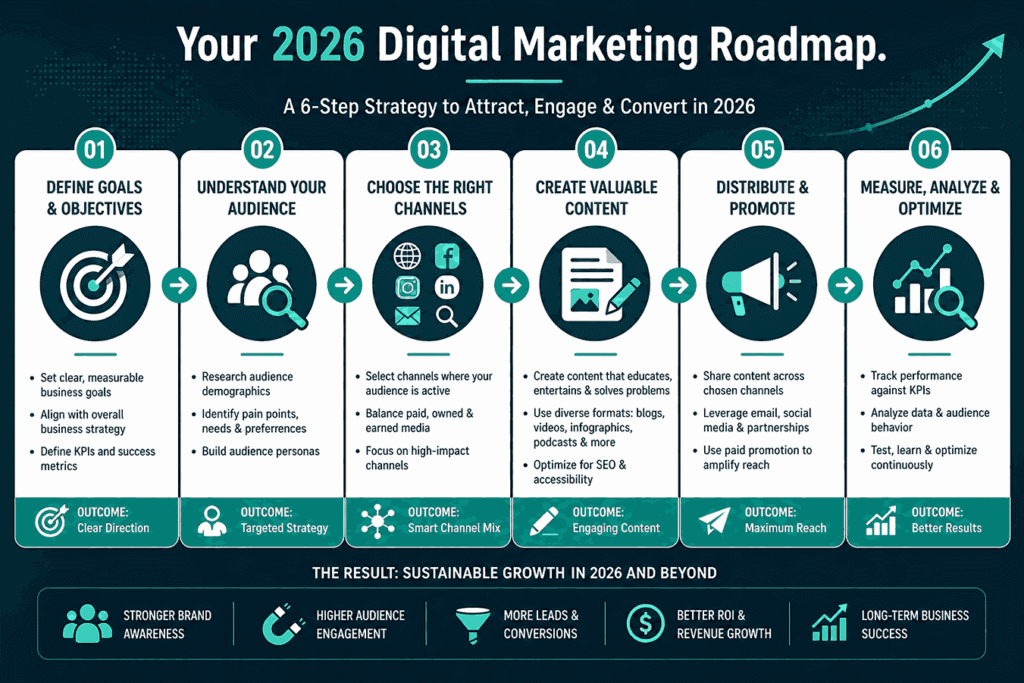
How to Build a Digital Marketing Strategy That Actually Works
Understanding what digital marketing is only takes you so far. What truly matters is putting it into action with a clear strategy.
Here’s a simple 6-step framework:
Step 1: Define Your Goals Be specific. “Get more customers” is not a goal. “Generate 200 leads per month through SEO and email marketing by Q3 2026” is a goal.
Step 2: Identify Your Target Audience Create a detailed buyer persona. Know their age, income, pain points, favourite platforms, and buying triggers.
Step 3: Choose Your Channels Don’t try to be everywhere at once. Start with 2–3 channels that align with your audience and goals. A B2B software company should prioritise LinkedIn and SEO. A fashion brand should focus on Instagram and Pinterest.
Step 4: Create Valuable Content Content is the fuel that powers every digital marketing channel. Plan a content calendar and commit to consistency.
Step 5: Distribute and Promote Publishing content is only half the battle. Distribute it through email, social media, paid ads, and outreach to ensure it reaches your target audience.
Step 6: Measure, Analyse, and Optimise Review your KPIs weekly. Track what’s working, eliminate what’s not, and continuously improve.
Real-World Example: How a Small Business Used Digital Marketing to 10x Revenue
Let’s bring this to life with a story.
Priya runs a handmade jewellery business from her home in Jaipur. In 2023, she was selling mostly at local exhibitions. Revenue was inconsistent, and growth was slow.
In early 2024, she made one decision: invest in digital marketing.
Here’s what she did:
- Set up an Instagram account and started posting daily Reels showcasing her jewellery-making process.
- Launched an SEO-optimised website on Shopify with product descriptions targeting keywords like “handmade silver jewellery online India.”
- Built an email list by offering a 10% discount to subscribers.
- Partnered with 3 micro-influencers in the lifestyle and fashion space.
Results after 12 months:
- Instagram followers grew from 0 to 47,000
- Website traffic increased to 15,000 visitors/month
- Monthly revenue grew from ₹35,000 to ₹3.8 lakhs
Digital marketing didn’t just help Priya grow — it transformed her hobby into a thriving business.
Digital Marketing vs Traditional Marketing: Which Is Better?
The honest answer? It depends on your business and goals. But for most small to medium businesses in 2026, digital marketing offers a significantly higher ROI.
Here’s why:
- Measurability: Every digital campaign is trackable. Traditional marketing often isn’t.
- Flexibility: You can pause, adjust, or scale a digital ad in minutes. A magazine ad takes weeks to change.
- Cost: A Facebook ad campaign can start with as little as ₹500/day. A full-page newspaper ad can cost ₹1 lakh+.
- Engagement: Digital marketing allows two-way conversations. Traditional marketing is one-directional.
That said, for certain industries — luxury brands, local events, and mass consumer products — a combination of both (integrated marketing) yields the best results.
Top Digital Marketing Tools You Should Know in 2026
Here are the essential tools across key categories:
SEO Tools:
- Google Search Console (free)
- Ahrefs
- SEMrush
- Moz
Social Media Tools:
- Buffer
- Canva (for visuals)
- Meta Business Suite
Email Marketing Tools:
- Mailchimp
- ConvertKit
- Klaviyo
Analytics Tools:
- Google Analytics 4
- Hotjar
- Microsoft Clarity
AI-Powered Tools:
- ChatGPT / Claude (content and strategy)
- Jasper (ad copy)
- Surfer SEO (content optimisation)
Conclusion: The Future Is Digital — And It Starts Now
So, what is digital marketing? It’s the most powerful, measurable, and scalable way to grow your business in 2026. It’s the art of showing up in the right place, at the right time, with the right message — and it’s available to every business, regardless of size or budget.
From SEO and social media to email automation and AI-powered campaigns, digital marketing offers a toolkit that traditional marketing simply cannot match. The businesses that thrive in the next decade will be those that understand this and take action today.
Whether you’re just starting out or looking to scale an existing operation, the fundamentals remain the same: know your audience, create value, be consistent, and let the data guide your decisions.
The question isn’t whether digital marketing works. The question is: can your business afford NOT to use it?
🌐 Ready to Grow Your Business Online?
Stop leaving money on the table. If you’re serious about growing your brand, driving real traffic, and converting visitors into loyal customers, it’s time to build a digital marketing strategy that works.
👉 Start Your Free Digital Marketing Audit Today with 18 Media Advertising — Discover exactly where your business stands online and what you need to do to dominate your market in 2026.
Frequently Asked Questions About Digital Marketing
Q1. What is digital marketing in simple words?
Digital marketing is promoting your business online — through Google, social media, email, and websites — to attract, engage, and convert customers. It’s any marketing that happens on a digital device or platform.
Q2. Is digital marketing a good career in 2026?
Absolutely. The demand for digital marketing professionals continues to surge globally. According to LinkedIn, digital marketing roles are among the top 10 most in-demand jobs. Skills in SEO, paid advertising, content marketing, and data analytics are especially valuable.
Q3. How much does digital marketing cost for a small business?
Costs vary widely. You can start with as little as ₹5,000–₹10,000/month for basic social media advertising and email tools. A more comprehensive strategy — including SEO, PPC, and content creation — might range from ₹25,000 to ₹2,00,000/month depending on your goals and industry.
Q4. How long does it take to see results from digital marketing?
It depends on the channel. PPC ads can generate results within 24–48 hours. SEO typically takes 3–6 months to show significant traction. Email marketing and social media often show results within weeks if done consistently. The key is long-term commitment — the compounding effect of digital marketing grows significantly over time.
Q5. Can I do digital marketing myself, or do I need an agency?
You can absolutely start on your own — especially with the abundance of free resources, tools, and platforms available. Many small business owners manage their own social media and email marketing. However, as your business grows, working with a freelancer or agency for specialised tasks like SEO, PPC, and strategy can save time and accelerate results.