Introduction: You’re Already Experiencing Digital Marketing — You Just Don’t Know It
Think about the last time you Googled a product before buying it. Or noticed an ad that seemed to “read your mind” right after you searched for something. Or clicked a YouTube video that helped you decide between two options.
That entire experience? That’s digital marketing meaning in real life — playing out right in front of you, every single day.
Digital marketing is one of those terms that gets thrown around constantly but rarely explained clearly. Is it just social media? Is it running ads? Is it blogging? Before diving deeper, it’s important to know the digital marketing meaning. The answer is — it’s all of that, and so much more.
In this guide, we’re going to strip away the confusion and break down exactly what digital marketing means, why it matters enormously in 2026, and how anyone — from a student to a seasoned business owner — can understand and use it to their advantage. The digital marketing meaning becomes clearer with real-world examples.
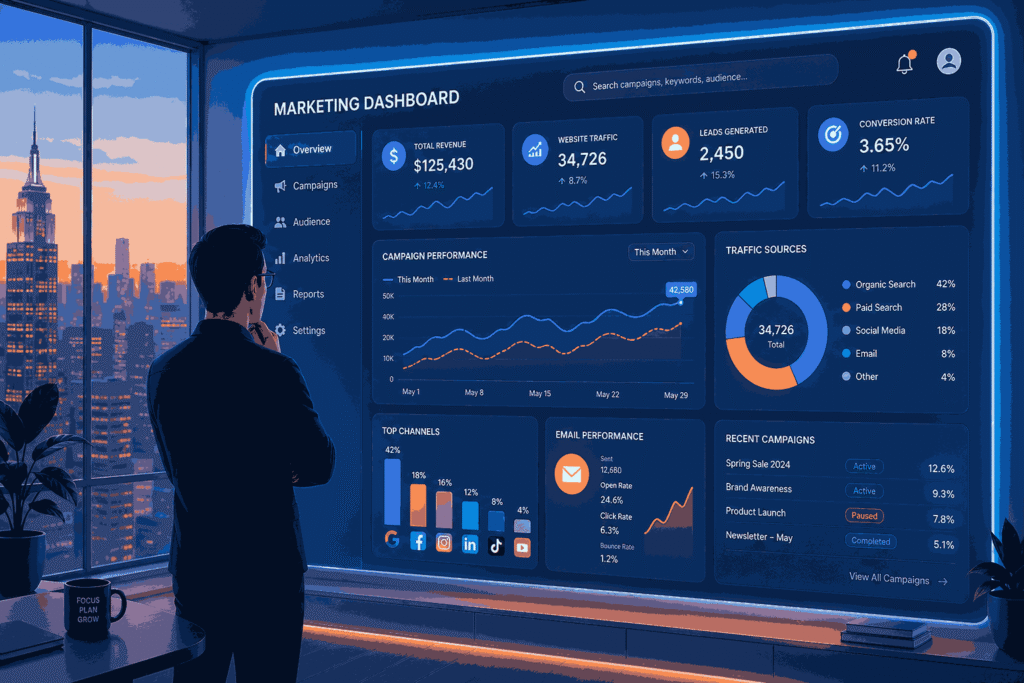
A professional reviewing a sleek digital marketing dashboard displaying campaign analytics, social media performance, and email metrics in a modern city office setting.
The Core Digital Marketing Meaning — Defined Simply
So, what does digital marketing actually mean?
Digital marketing is the promotion of a product, service, or brand through digital channels — primarily the internet — to reach and influence a target audience. If you’re new, you might be curious about the digital marketing meaning. The digital marketing meaning is often misunderstood by beginners. It encompasses everything from appearing in Google search results to sending an email newsletter to running a paid ad on Instagram.
If traditional marketing spoke to audiences through television, print, and radio, digital marketing speaks to them through search engines, websites, social platforms, email inboxes, and mobile apps.
But here’s what makes the digital marketing meaning richer than a dictionary definition — it’s not just about promotion. It’s about connection. It’s about reaching the right person, with the right message, at exactly the right moment.
A Story That Puts It in Perspective
Let’s talk about Arjun.
Arjun runs a small coaching institute in Nagpur that prepares students for competitive entrance exams. For years, he relied on word of mouth and a few banners near his coaching center. Business was okay — but growth was slow, and he always worried about the next intake cycle.
A friend suggested he try digital marketing. Reluctantly, he started a blog answering common questions like “how to prepare for JEE in 6 months” and “best study strategies for NEET.” He created a simple YouTube channel with free tips. He set up a Google Business profile and asked happy students to leave reviews.
Within a year, his institute’s inquiries had doubled. Students from outside Nagpur were reaching out after finding him on Google. He hadn’t spent a fortune — he’d just learned to show up online where his audience was already looking.
That’s the real-world power behind the digital marketing meaning.
Why the Digital Marketing Meaning Has Evolved in 2026
Digital marketing isn’t what it was five years ago — and understanding how it’s evolved helps you appreciate why it matters so deeply today. Digital marketing isn’t what it was five years ago — and understanding how it’s evolved helps you appreciate why it matters so deeply today. The digital marketing meaning is the starting point for anyone entering this field.
In the early days of the internet, digital marketing meant banner ads and email blasts. It was interruptive, impersonal, and largely one-directional.
Today, it’s a sophisticated, data-driven, audience-first discipline. Here’s what’s changed:
Personalization is everything. Consumers now expect brands to know who they are and speak to their specific needs — not blast generic messages to everyone.
Content is the currency. Audiences reward brands that educate, entertain, and genuinely help them — not just brands that sell hard.
Data guides every decision. Every click, scroll, and conversion leaves a digital trail. Smart marketers follow that trail to continuously improve results.
Mobile has taken over. Over 60% of global web traffic comes from mobile devices. Digital marketing in 2026 is, in many ways, mobile marketing.
Video dominates. Short-form video (Reels, Shorts, TikTok-style content) has fundamentally shifted how brands communicate.
Understanding the digital marketing meaning in 2026 means understanding all of these shifts — and using them to your advantage. People often overlook the true digital marketing meaning. Understanding the digital marketing meaning can change your perspective on business because The digital marketing meaning plays a key role in modern business success.
The 8 Pillars That Define the Digital Marketing Meaning
When people ask “what is digital marketing?” they’re really asking about an ecosystem of interconnected strategies. Many people try to understand the digital marketing meaning before exploring further. At a basic level, the digital marketing meaning is simple yet powerful. The digital marketing meaning forms the base of every online campaign.
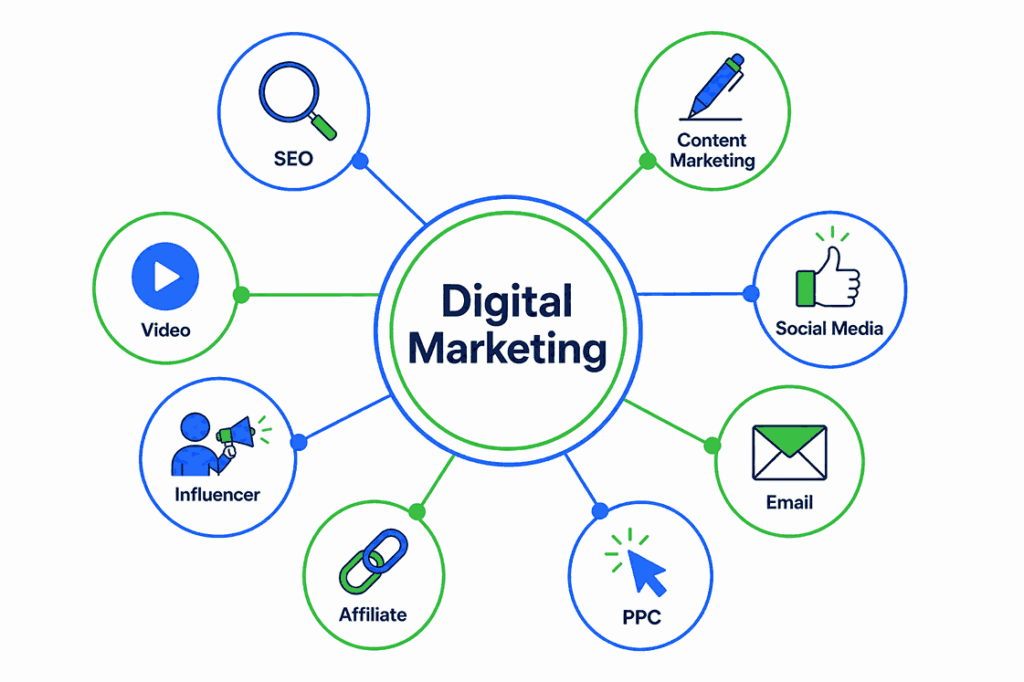
Here are the eight pillars that make up that ecosystem:
1. Search Engine Optimization (SEO)
SEO is the practice of optimizing your online content so that search engines like Google rank it higher in their results. When someone searches “best yoga classes in Pune,” the websites that appear on page one didn’t get there by accident — they got there through SEO.
Key elements of SEO:
Keyword research – Understanding exactly what your audience types into search engines
On-page optimization – Structuring your content, headings, and meta tags correctly
Link building – Earning references (backlinks) from other credible websites
Technical health – Site speed, mobile responsiveness, and clean code
SEO is a long game. But when it pays off, it delivers free, consistent, compounding traffic — month after month.
2. Content Marketing
Content marketing means creating genuinely useful content — blogs, videos, infographics, guides, podcasts — that attracts and retains your target audience.
The idea is simple: if you consistently answer your audience’s questions and solve their problems through content, they’ll trust you. And trust leads to business.
Real-world example: Nykaa built a massive beauty community in India partly through their editorial content — beauty tutorials, product guides, and skin care advice. Before you buy, you learn. That’s content marketing at its best.
3. Social Media Marketing
Social media marketing involves building and engaging your brand’s presence on platforms like Instagram, LinkedIn, Facebook, YouTube, and X (formerly Twitter).
It can be:
Organic — Regular posts, stories, reels, polls, and community engagement (free, but requires effort)
Paid — Boosted posts and targeted ads that reach specific audiences based on demographics, interests, and behavior
With over 5 billion active social media users globally in 2024, social media marketing isn’t optional — it’s a primary channel for most businesses.
Despite being decades old, email marketing remains one of the most profitable digital marketing channels available. Studies consistently show it returns approximately $36–$42 for every $1 invested — a return most channels simply can’t match.
Great email marketing involves:
Welcome email sequences for new subscribers
Value-driven newsletters
Promotional campaigns for product launches or offers
Abandoned cart and re-engagement emails
The secret? Don’t just sell in every email. Build a relationship first. Deliver value every single time someone opens your message.
5. Pay-Per-Click Advertising (PPC)
PPC is paid advertising where you only pay when someone actually clicks your ad. Google Ads is the most widely used PPC platform — powering those “Sponsored” results you see at the top of every Google search.
PPC is ideal when you need:
Fast visibility and traffic (unlike SEO, results are near-immediate)
Promotion of a specific product, event, or offer
Retargeting people who visited your site but didn’t convert
The challenge with PPC is that it requires careful management. Without proper strategy, budgets can drain quickly without meaningful results.
6. Affiliate Marketing
Affiliate marketing is a performance-based model where you pay third parties (affiliates) a commission for sending customers your way. The affiliate promotes your product through their blog, social media, or email list — and earns a percentage of every resulting sale.
It’s a win-win: you get exposure without upfront advertising costs, and affiliates earn income from their audience.
7. Influencer Marketing
Influencer marketing means partnering with individuals who have established audiences — on Instagram, YouTube, LinkedIn, or elsewhere — to promote your product or service in an authentic way.
The spectrum is wide:
Mega-influencers (millions of followers) — Great for brand awareness
Micro-influencers (10K–100K followers) — Often deliver higher engagement rates and stronger niche trust
For many small businesses, a single post from the right micro-influencer can deliver better results than a large paid ad campaign.
8. Video Marketing
Video has become the dominant content format online. YouTube is the second-largest search engine in the world. Instagram Reels and YouTube Shorts are reshaping how brands communicate in under 60 seconds.
According to Wyzowl’s annual research, over 91% of businesses now use video as a marketing tool, and the vast majority report a strong ROI from it.
Video builds trust and emotional connection faster than any other format. If you’re not creating video content in 2026, you’re leaving significant audience reach on the table.
A clean landscape infographic illustrating the core components of digital marketing, including SEO, content marketing, social media, email, PPC, affiliate, influencer, and video marketing.
How Digital Marketing Guides the Customer Journey
One of the most practical ways to understand the digital marketing meaning is to see how it works across the full customer journey, the digital marketing meaning plays a key role in modern business success. — from a stranger discovering your brand to becoming a loyal, repeat buyer.
Marketers commonly use the AIDA model to map this:
A — Awareness The customer discovers your brand for the first time. Maybe through a Google search, a social media reel, a YouTube video, or a blog post. SEO, content marketing, and social media are the primary drivers here.
I — Interest Curiosity is piqued. They explore your website, read more of your content, subscribe to your newsletter, or follow you on Instagram. Content marketing and email capture are critical at this stage.
D — Desire They’re warming up. They’ve seen enough to be interested but aren’t quite ready to commit. This is where retargeting ads, testimonials, case studies, and nurture email sequences do their work.
A — Action The moment of decision. They buy, book, subscribe, or contact you. A strong offer, clear call-to-action, and smooth user experience seal the deal.
The beautiful thing about digital marketing is that it has tools designed specifically for each of these stages. Nothing is left to chance — or at least, it doesn’t have to be.
The Numbers That Make the Digital Marketing Meaning Undeniable
Numbers often speak louder than explanations. Here’s what the data tells us about digital marketing in 2026:
There are over 5.4 billion internet users globally — roughly 67% of the world’s entire population.
Global digital advertising spend is projected to surpass $870 billion by 2026.
81% of shoppers research a product online before making a purchase — even when buying in a physical store.
Businesses that publish consistent blog content generate approximately 67% more leads per month than those that don’t.
Email marketing delivers an average ROI of $36–$42 per $1 spent.
Over 90% of marketers who use short-form video say it delivers positive ROI for their brand.
What do all these numbers point to? The same conclusion: digital is where your audience lives, and digital marketing is how you reach them.
Digital Marketing Meaning for Every Type of Business
A persistent myth is that digital marketing only works for large brands or tech companies. The reality is the opposite — it’s one of the most powerful tools available to small businesses and individuals.
For Local Businesses
A local salon, restaurant, or clinic can benefit enormously from:
A fully optimized Google Business Profile (appears in map results and local searches)
Customer reviews and ratings building local trust
Local SEO targeting neighborhood-specific keywords
Instagram content showcasing work, products, or atmosphere
This kind of local digital presence can drive foot traffic and bookings consistently without large budgets.
For E-Commerce Brands
For online stores, digital marketing is the engine that powers everything:
SEO drives organic product discovery
Google and Meta Ads bring in targeted paid traffic
Email sequences convert browsers into buyers and buyers into repeat customers
Influencer partnerships build product credibility through trusted voices
Every rupee or dollar spent can be directly tracked to a sale — making digital marketing uniquely accountable.
For B2B Companies
Business-to-business companies play a longer game, but digital marketing is equally vital:
LinkedIn content and ads reach decision-makers directly
Long-form SEO content positions you as an industry authority
Webinars and virtual events build relationships at scale
Case studies and white papers demonstrate expertise and results
For Personal Brands and Freelancers
In 2026, your digital presence is your resume. Consistent content on LinkedIn, a personal blog, or a niche YouTube channel can generate more client inquiries than cold pitching ever could.
Coaches, consultants, designers, writers, and educators are building full-time businesses entirely through digital marketing — with no physical office, no traditional advertising, and no massive startup costs.
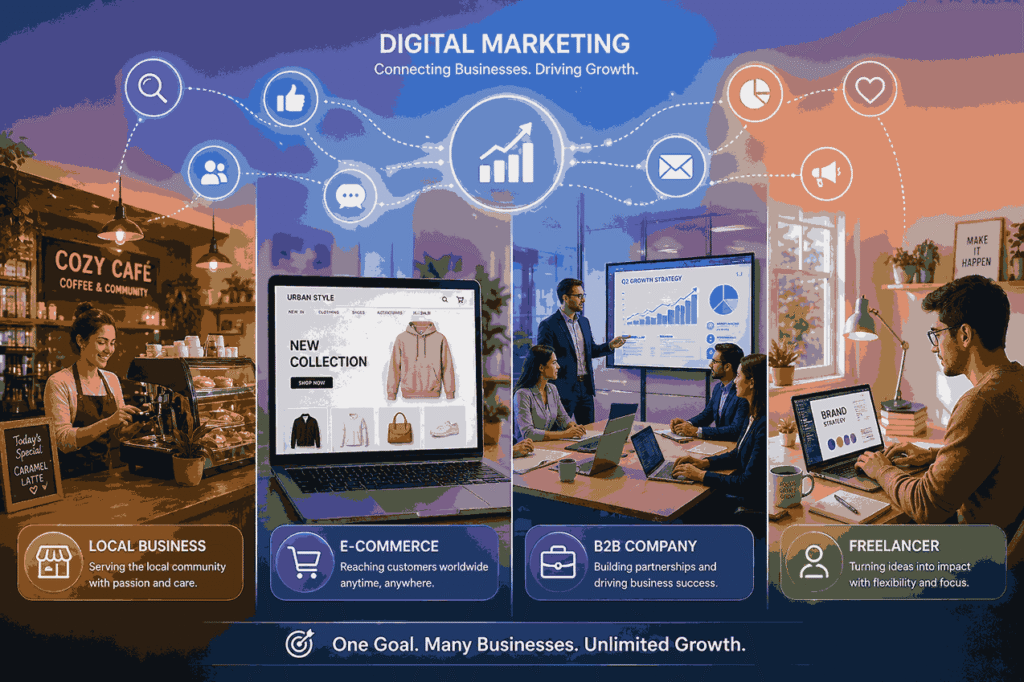
A landscape illustration highlighting how digital marketing supports local businesses, e-commerce, B2B companies, and freelancers through connected online channels.
Common Mistakes That Come From Misunderstanding the Digital Marketing Meaning
Getting clarity on what digital marketing truly means also helps you avoid the most common pitfalls:
Mistake 1: Confusing activity with strategy. Posting on social media every day without a clear audience, goal, or message isn’t digital marketing. It’s digital noise. True digital marketing is intentional and goal-driven.
Mistake 2: Trying to be on every platform at once. More platforms don’t equal more results. Starting with one or two channels and mastering them is far more effective than spreading yourself thin across six.
Mistake 3: Ignoring analytics. If you’re not tracking your results, you can’t improve them. Google Analytics, social media insights, and email open rates are your feedback loops — use them.
Mistake 4: Expecting overnight results. Channels like SEO and content marketing are long-term plays. If you quit after three months because you’re not seeing dramatic results, you’ve given up just before the momentum kicks in.
Mistake 5: Treating all channels the same. LinkedIn requires different content than Instagram. What works on YouTube won’t necessarily work via email. Each channel has its own language, rhythm, and audience expectation.
How to Start Applying the Digital Marketing Meaning to Your Own Business
Understanding the theory is one thing. Starting is another. Here’s a simple roadmap:
Set a specific goal. More website traffic? More leads? More sales? Pick one primary objective before anything else.
Define your target audience. Get specific — age, location, interests, pain points, aspirations. The more clearly you know your audience, the more effectively you can reach them.
Choose 1–2 starting channels. Based on your audience and goal, select the most relevant channels. Don’t try to master everything at once.
Build your content plan. Decide what you’ll publish, how often, and in what format. Consistency matters more than perfection.
Set up measurement from day one. Install Google Analytics, set up Google Search Console, and monitor your social media insights regularly.
Publish, analyze, and improve. Launch your first campaign or content piece. Check the data. See what’s working. Do more of that. Cut what isn’t.
Stay consistent for at least 6 months. This is where most people fail — and where the most successful ones separate themselves.
Conclusion: The Digital Marketing Meaning — And Why It’s Your Most Important Business Skill in 2026
Let’s tie it all together.
The digital marketing meaning isn’t just a textbook definition. It’s an understanding of how the modern world connects, communicates, and makes decisions — and how your business can be part of those conversations in a meaningful way.
We covered a lot of ground in this guide. Here’s a quick summary of what we explored:
Digital marketing meaning at its core — promoting brands through digital channels to reach and influence the right audience
The 8 pillars: SEO, content marketing, social media, email, PPC, affiliate marketing, influencer marketing, and video
How digital marketing maps to every stage of the customer journey using the AIDA framework
Why it matters more than ever in 2026, backed by powerful data
How it applies to every business type — local shops, e-commerce, B2B, and personal brands
Common mistakes to avoid — and a practical roadmap to get started today
If there’s one thing to take away from everything above, it’s this: digital marketing meaning is not optional anymore. Your audience is online. Your competitors are online. The question is simply whether you’ll show up — or whether you’ll leave that space to someone else.
You now have the knowledge. The next step is entirely yours.
🚀 Ready to Put This Into Action?
Don’t let this be just another article you read and forget.
Explore our services of SEO, social media strategy, and digital marketing to go deeper into each channel, one step at a time.
👉 The digital world is growing every single day. Make sure your brand grows with it.Connect with 18 Media Advertising and explore our Digital Marketing Services.
FAQ: Digital Marketing Meaning — Your Questions Answered
Q1: What is the basic digital marketing meaning in simple terms? At its simplest, digital marketing meaning refers to promoting your business or brand using the internet — through tools like Google search, social media, email, and online ads — to reach and engage the people most likely to become your customers.
Q2: Is digital marketing only about social media? No — this is one of the most common misconceptions. Social media is just one component of digital marketing. The full picture includes SEO, content marketing, email, paid advertising, affiliate marketing, influencer partnerships, and video marketing, among others.
Q3: What is the digital marketing meaning for a small business with a limited budget? Small businesses can actually thrive with digital marketing on minimal budgets. Organic SEO, content marketing, Google Business Profile optimization, and consistent social media posting are all powerful strategies that cost nothing but time and effort. Paid channels can be added gradually as the business grows.
Q4: How is the digital marketing meaning different from traditional marketing? Traditional marketing uses offline channels like TV, radio, print, and billboards — broad reach with limited targeting and difficult-to-measure results. Digital marketing uses online channels — precisely targeted, highly measurable, often more cost-effective, and interactive rather than one-directional.
Q5: Can I learn digital marketing on my own, and how long does it take? Absolutely. Numerous free resources — Google’s Digital Garage, HubSpot Academy, YouTube tutorials, and countless blogs — make self-learning accessible to anyone. A solid foundational understanding can be built in 2–3 months. Practical expertise comes from hands-on experience over time. Like most valuable skills, digital marketing rewards continuous learning.